

Business Operation · 2025
In this section23 topics
- Corporate Information4 items
- Dividend Policy2 items
- Major Shareholders2 items
- Business Strategies Overview6 items
- Material Changes & Developments1 item
- Use of Proceeds from Securities Offerings4 items
- Commitments Made in the Registration Statement2 items
- Group Operating-Structure Policy1 item
- Companies Where the Company Holds ≥10%1 item
- Shareholders with Potential Conflict of Interest1 item
- Relationships Among Major Shareholders2 items
- Shareholders' Agreement1 item
- Shareholding Diagram (Group Structure)2 items
- Income Structure4 items
- Product / Service Characteristics2 items
- Research & Development5 items
- Assets Used in the Business4 items
- Marketing Policy & Competition3 items
- Procurement of Products & Services2 items
- Nature of Business — Overview1 item
- Projects Under Construction1 item
- Debentures & Bills of Exchange4 items
- Convertible Securities1 item
Corporate Information
Company Name
KRUNGTHAI CARD PUBLIC COMPANY LIMITED
Telephone
0-2123-5000, 0-2123-5100
Website
www.ktc.co.th
cservice@ktc.co.th
Dividend Policy
Dividend Policy
The Company’s dividend payment policy is in accordance with the resolution of the Annual General Meeting No. 1/2003 on March 25, 2003, which approved the dividend payment at approximately 40% of the Company’s net profit after tax deduction and legal reserves from 2003 onwards.
Historical Dividend Payments
| This Year | Last Year | 2 Years Ago | 3 Years Ago | 4 Years Ago | Metric | Description | Remark |
|---|---|---|---|---|---|---|---|
| 3.21 | 2.92 | 2.81 | 2.77 | 2.42 | Net profit per share (Baht : Share) | Net profit per share (baht : share) | Separate financial statement |
| 1.77 | 1.32 | 1.27 | 1.15 | 1 | Dividend per share (Baht : Share) | Dividend per share (baht : share) | |
| 0 | 0 | 0 | 0 | 0 | Dividend stock ratio (Number of original shares: dividend shares) | Ratio of stock dividend payment (existing share : stock dividend) | |
| 0 | 0 | 0 | 0 | 0 | Dividend share value per share (Baht : Share) | Value of stock dividend per share (baht : share) | |
| 1.77 | 1.32 | 1.27 | 1.15 | 1 | Total dividend payment value (Baht : Share) | Total dividend payment (baht : share) | |
| 55.06 | 45.25 | 45.22 | 41.53 | 41.24 | Dividend payout ratio to net profit (%) | Dividend payout ratio compared to net profit (%) | The right to receive dividends is unconfirmed until approved in the Annual General Shareholders Meeting 2026 (No. 24) |
Business Strategies Overview
Chairman's Message
Vision
KTC is a membership company in payment and retail lending business with emphasis on being a trusted organization with sustainable growth.
Objectives
Build a high-quality foundation
Expand the member base and credit portfolio prudently, alongside effective risk management and asset quality control.
Advance digital transformation and data-driven operations
Differentiate products and services to enhance operational efficiency, develop innovative offerings, and elevate the member experience.
Build long-term relationships with members
Through products, services, and platforms that understand diverse lifestyles and needs, strengthening the KTC brand to remain top of mind among members.
Operate responsibly and sustainably
Under strong governance, transparency, and balanced stewardship of all stakeholder interests.
Goals
To enable members to access payment and consumer credit products and services conveniently, quickly, and securely.
To enhance organizational capabilities in technology, operational processes, and human capital in order to understand and respond effectively to members’ needs.
To create differentiation and competitive advantage in products and services.
To build long-term brand perception and strengthen member engagement with KTC.
To support stable and sustainable organizational growth together with our members.
Business Strategies
For 2025, KTC will execute its strategic roadmap to advance toward becoming a sustainable digital organization under the direction of “Building a Sustainable Future Through Digital Transformation,” anchored on four key pillars:
1. Reach Better: Expand the member base through digital channels, targeting new segments that prefer fully self-service onboarding. This includes enhancing the e-Application journey to be simpler, seamless, secure, and capable of delivering faster approval decisions. KTC will also develop and test new credit assessment and scoring tools to identify opportunities to responsibly grow the member base within acceptable risk parameters.
2. Grow Healthier: Strengthen the efficiency of member data management and expand service capabilities on the KTC Mobile application. These enhancements will enable members to conveniently access KTC products and services, meet their needs effectively, and reinforce confidence in usage and spending.
3. Bond Tighter: Improve the performance, safety, and user experience across digital touchpoints — including KTC Mobile, LINE Connect, Facebook, and www.ktc.co.th to create a simple, secure, and frictionless journey for members. Additionally, KTC will enhance tools for Contact Center teams to ensure faster, more accurate support and maximize member satisfaction.
4. Work Smarter: Equip KTC employees across the organization with the right tools, processes, and IT-focused upskilling programs. KTC will foster innovation and process improvement, leveraging technology to enhance productivity, optimize operating costs, and ensure employee capabilities progress in line with business transformation needs.
KTC continues to drive organizational development through sustainable strategies, building financial solutions that are effective, responsive to customer needs, and socially responsible — strengthening long-term financial resilience and enabling stable and sustainable business growth into the future.
Other Information
| Name | Description |
|---|---|
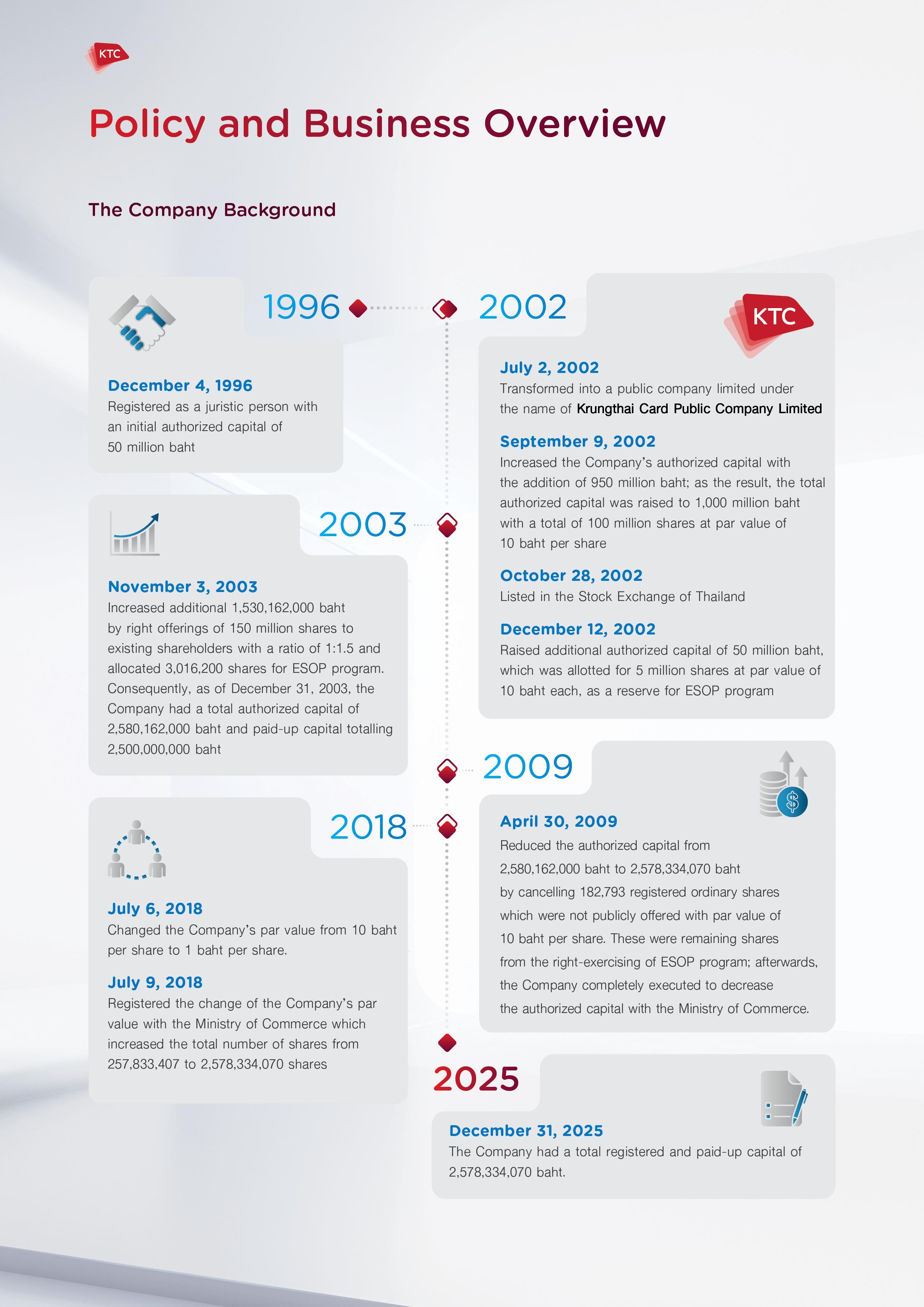
| The Company Background |
|
Material Changes & Developments
Material Changes & Developments
| Year | Description |
|---|---|
| 2,023 |
|
| 2,024 |
|
| 2,025 |
|
Use of Proceeds from Securities Offerings
Introduction
As of December 31, 2025, the Company had total outstanding debentures amounting to THB 35,612 million. The proceeds raised from these issuances have been fully utilized in accordance with the objectives specified in the respective debt securities registration statements and prospectuses. Further details regarding these debentures are available in Section 1.5.2: Debt Securities.
Is There Money Raised from a Securities Offering Still to Report On?
Yes
Offerings
| Type of Securities | Type — Please Specify | Amount Raised Given As | Amount Raised (Million Baht) | Uses of the Money | Used as Declared? | Progress / Reasons and Measures if Not Used as Declared | Related Link |
|---|---|---|---|---|---|---|---|
| Other | DEBENTURES OF KRUNGTHAI CARD PUBLIC COMPANY LIMITED NO. 1/2023 DUE 2026 | 2873 | 4,000 | 2023-06 · Objective: Intended to raise funds for repayment of loans in June 2023 · Period type: 2871 · Start period: 2023-06 · Spent amount type: 2873 · Start spent amount: 4000.0 · Expected amount type: 2873 · Start expected amount range: 4000.0 | Y | The Company has fully utilized the funds raised in accordance with the objectives specified in the Registration Statement for the offering of debt securities (Filing). | https://market.sec.or.th/public/ipos/IPOSDE01.aspx?TransID=529916&SD=2505256626052566 |
Law Governing the Debt Securities
Applicable laws for the issue and offer of securities for sale are Thai laws including Securities and Exchange Act B.E. 2535, and other regulations or announcements related to such laws.
Commitments Made in the Registration Statement
Are There Commitments or Conditions from an Offering or Listing?
Yes
Commitments and How They Were Met
For the issue and offer for sale of the Company’s securities, the Company has complied with rules of related law according to each type of securities or as specified in the registration statement for the offer for sale of each type of securities in terms of funds utilization objectives, prices, and interest rates, etc. In case of a change of the Company’s important information that affects securities price or investors, the Company will disclose such information through the Securities and Exchange Commission and the Stock Exchange of Thailand system, or the Company's website in accordance with the time specified by law.
Group Operating-Structure Policy
Description
Krungthai Card Public Company Limited engages primarily in the credit card business, including related services such as merchant acquiring, payment services, and personal loans. Its lending portfolio covers regulated personal loans and auto title loans. The Company has also established subsidiaries to broaden its financial product offerings, encompassing nano finance for occupational purposes, hire purchase, and leasing businesses.
KTC Nano Company Limited operates a regulated nano finance business for occupational purposes. In light of elevated household debt levels and the rising trend of non-performing loans, the company is currently in the process of evaluating business opportunities.
KTB Leasing Company Limited engages in hire purchase and financial lease businesses. The company ceased new loan disbursements in August 2023 and is presently focused solely on debt collection and the management of its existing loan portfolio.
KTC Prepaid Company Limited operates regulated payment services, including e-money issuance, electronic funds transfer services, and payment services. On January 9, 2026, KTC Prepaid Company Limited (“KTCP”) was granted approval by the Bank of Thailand to return its business license. The company is currently undergoing the legal dissolution process, which is expected to be completed within the second quarter of 2026. The dissolution will not have any impact on KTC’s operating results or financial position.
Companies Where the Company Holds ≥10%
Companies (≥10% Holding)
| Company Name | Address | Province | Zip Code | Telephone | Business Type | Security Type | Shares | Paid-up Shares |
|---|---|---|---|---|---|---|---|---|
| KTC Prepaid Co., Ltd | 591 UBC II Building, Room 1107, 11th Floor, Sukhumvit Road, North Klongton, Wattana | Bangkok | 10110 | 02-123-5100 | KTC Prepaid Company Limited engages in payment service under supervision which consisted of electronic payment, electronic money transfer, and payment gateway. | Common shares | 15,000,000 | 15,000,000 |
| KTC Nano Co., Ltd. | 591 UBC II Building, Room 1002 (Zone B) 10th Floor, Sukhumvit Road, North Klongton, Wattana | Bangkok | 10110 | 02-123-5300 | KTC Nano Company Limited engages in a nationwide business-related loan under supervision. | Common shares | 5,000,000 | 5,000,000 |
| KTB Leasing Co., Ltd. | 591 UBC II Building, 2nd Floor, Sukhumvit Road, North Klongton, Wattana | Bangkok | 10110 | 02-407-1555, 02-407-1578 | KTB Leasing Company Limited operates hire purchase and financial lease business. | Common shares | 100,000,000 | 100,000,000 |
Income Structure
Introduction
The Company's revenue structure is primarily comprised of interest income and fee income generated from its two core businesses, namely the credit card and the personal loan business.
According to the 2023 financial statements, the Company recognized credit usage fee, which is calculated based on the outstanding balances. Since August 1, 2020, in accordance with the Bank of Thailand’s announcement, the maximum allowable interest rates for credit cards and personal loans are capped at 16% and 25% per annum, respectively. For personal loans under supervision business with a car registration as collateral, the interest rate stands at 24% per annum. The difference between the interest rates and fee income permitted under the Civil and Commercial Code and those regulated by the Bank of Thailand are logged as credit usage fee.
Starting from the first quarter of 2024, the Company has reclassified interest and income from credit usage fee to be classified as “interest income”, which is included under the “Interest Income” category. In addition to interest income, the Company generates revenue from bad debt recovery and other incomes.
In May 2021, the Company acquired ordinary shares of KTB Leasing Co., Ltd. to expand into the hire purchase and financial leasing sectors. However, due to increasing signs of non-performing loans, the Company discontinued the issuance of commercial loans from August 2023 to improve the loan processes and managing the portfolio quality.
Product / Service Income
| Category | Description | This Year | This Year % | Last Year | Last Year % | 2 Years Ago | 2 Years Ago % |
|---|---|---|---|---|---|---|---|
| Total revenue from operations | Total revenue from operations | 27,695,017.11 | 100 | 27,455,588.85 | 100 | 25,418,462.25 | 100 |
| Credit Card Revenue | 16,273,687.64 | 58.76 | 16,274,404.5 | 59.28 | 15,057,304.63 | 59.24 | |
| Personal Loan Revenue | 10,340,732.87 | 37.34 | 10,100,133 | 36.79 | 9,406,738.69 | 37.01 | |
| Leasing Revenue | 189,668.76 | 0.68 | 301,249.11 | 1.1 | 361,771.01 | 1.42 | |
| Other | Other | 890,927.83 | 3.22 | 779,802.24 | 2.84 | 592,647.92 | 2.33 |
Export Income
| Category | Description | This Year | This Year % | Last Year | Last Year % | 2 Years Ago | 2 Years Ago % |
|---|---|---|---|---|---|---|---|
| Total revenue | Total revenue from operations | 27,695,017.11 | 100 | 27,455,588.85 | 100 | 25,418,462.25 | 100 |
| Domestic | Domestic | 27,695,017.11 | 100 | 27,455,588.85 | 100 | 25,418,462.25 | 100 |
| International | International | 0 | 0 | 0 | 0 | 0 | 0 |
Other Income
| Operating Other Income | Non-Operating Other Income | Share of Profit |
|---|---|---|
| 1710 · As of year: 646860413.8 · Description: Total other income · As of yesteryear: 554140449.0 · As of year before yesteryear: 456066189.0 · 1711 · As of year: 646860413.8 · Description: Other income from operations · As of yesteryear: 553193651.04 · As of year before yesteryear: 456066189.0 | 1712 · As of year: 0.0 · Description: Other income not from operations · As of yesteryear: 946798.0 · As of year before yesteryear: 0.0 | 1713 · As of year: 0.0 · Description: Share of profit · As of yesteryear: 0.0 · As of year before yesteryear: 47022.63 |
Product / Service Characteristics
Business Type
3115
Business Groups
| Business Group | Description | ||||||||||||
|---|---|---|---|---|---|---|---|---|---|---|---|---|---|
| Credit Card Business | The credit card business consists of two components: card issuing and merchant acquiring businesses. The card issuing business ranges from recruiting prospective credit card customers, approving a credit limit for cardholders, regulating credit card spending, receiving debt payment and pursuing debts. With this, the issuing bank/ card issuer earns income from transaction fees and interest charges. As for merchant acquiring business, it is a business that deals with merchants that accept credit card payment for goods and services. In the process, the Company selects and installs card swipe machines and/ or set up a payment gateway system at stores so that it can oversee credit card acceptance for payment of goods and services by cardholders. Finally, the Company can generate fee income based on this process as aforementioned.
Issuing business The Issuing Business is an integral part of KTC's operations as a bank/ company issuing credit cards (Issuing Bank). The Company is authorized to issue credit cards bearing the Visa, Mastercard, JCB and UnionPay logos. These cards are affiliated with Visa International (Thailand) Ltd., Mastercard Asia/Pacific Pte., Ltd, JCB International Co., Ltd., and UnionPay International Co., Ltd., which act as intermediaries facilitating payment transactions between issuing banks/ companies and banks/ companies of merchants. Cardholders have the option to choose credit cards issued in collaboration with Visa, Mastercard, JCB, or UnionPay. These cards can be used for cashless transactions to pay for goods and services at all participating merchants displaying the Visa, Mastercard, JCB and UnionPay logos.
The Company offers several types of credit cards as follows: 1.Generic Credit Card in a form of KTC, VISA/ MASTERCARD/ JCB/ UNIONPAY credit cards can be used by cardholders to pay for goods and services in lieu of cash at any service outlets or stores displaying the Visa, Mastercard, JCB and UnionPay logos throughout the world. In addition, cardholders can also withdraw a cash advance, jointly issue credit cards for three core groups of customers: Super-Premium, Premium and General. In 2024, the launch of the KTC DIGITALPLATINUM credit card aims to enhance security measures and provide more options for customers.Subsequently in 2025, the company further expanded its KTC Digital credit card portfolio by introducing the Signature and World Rewardstypes. Targeting individuals with a minimum monthly income of 50,000 Baht, these cards provide enhanced privileges and a superior user experience tailored to the unique requirements of high-income earners. 2.Co-Branded Card is a credit card jointly issued by KTC and its commercial partners. Cardholders can use a co-branded card for payment of goods and services in lieu of cash to any merchants. In addition, the credit cardholders will receive more privilege if they use this card at the merchants that are joint card issuers. 3.Affinity Credit Card is credit card issued in conjunction with alumni institutions or non-profit organizations, i.e., the Thai Pilots Association, theNational Blood Center, Thai Red Cross Society, Chulalongkorn University Engineering Alumni Association, National Defense Studies Institute of the Royal Thai Armed Forces Headquarters, and Suankularb College Alumni Association under the Royal Patronage. 4.Government ServicesCredit Card is a credit card for government agencies that helps facilitating the government budget spending and reduces the burden and risks of holding cash for government entities. 5.Corporate Credit Card is credit cards for public organizations, independent organizations, private companies, etc. These help to manage the organization's spending more conveniently and increases transparency of the company's work processes. (A) Types of services offered by card issuing business The Company offers cardholders a multitude of services and benefits as follows: 1.Payment of goods and services in lieu of cash payment: The Company's credit cardholders can pay for goods and services at stores with the Visa, Mastercard, JCB and UnionPay logosin Thailand and more than 200 countries, according to the credit limit of each approved credit cardholder. The Company pays for such goods and services to the merchant/ merchant company through the bank. When the credit cardholder's accounting period is due (interest-free repayment period of up to 45 days from the date of the balance sheet), the Company processes the payment from the credit cardholder. The credit cardholder is to choose to pay the Company in full amount based on the spending amount or minimum payment. According to the criteria to alleviate the burden of credit card members affected by the COVID-19 epidemic announced by the Bank of Thailand, the Company has had measures to help with credit for credit card members from March 26, 2020 to December 31, 2024 as follows: KTC has automatically reduced the minimum payment rate of credit card for credit card members, without having to individually request, reduced from the original 10% to:
2.Cash advance is a service that enables cardholders to withdraw cash by deducting a withdrawn amount from their approved credit lines. Cardholders can withdraw cash advance in Thailand and abroad. In case of domestic cash advance, cardholders can either withdraw cash advance from any bank ATMs withthe ATM POOL, PLUS, Cirrus, Visa, Mastercard, JCB and UnionPay logosr withdraw from any Krungthai Bank counters displaying “we accept credit cards” sign of VISA/ MASTERCARD/ JCB/ UNIONPAY. In case of overseas withdrawal, cardholders can either withdraw cash advance from ATMs with the PLUS, Cirrus, Visa, Mastercard, JCB and UnionPay logos or withdraw from bank counters or any exchange booth displaying “we accept Visa, MasterCard, JCB and UnionPay” sign. Moreover, cardholders can also make online cash withdrawal on the website (via KTC Online) and any iOS/ Android/ Huawei’s Harmony OS for smartphones/ tablets (via KTC Mobile Application). The 24-hour online service will promptly transfer money to different banking accounts of 15 banks immediately. For this cash advance service, the Company receives a cash advance fee of 3% of the withdrawn amount from service users, but a minimum withdrawal amount must not be less than Baht 500. Furthermore, the Company can earn income from credit card interest, whereby it charges interest and credit usage fee from the date of cash withdrawal until the date of repayment of the entire outstanding amount. 3.Other supplementary services constitute of extra services or privileges offered to cardholders, including
4.Digital Marketing services
(B) Credit Card Service Process of Credit Card Issuing Business 1.Acquiring cardholders: The Company recruits cardholders through the main channels listed below:
2.Credit acceptance The Company established standard procedures and work processes for consideration and approval of credit lines. There is a due diligence on the customer information including the identity verification of the applicant to ensure that the Company receive up-to-date, accurate and complete information and that customer qualifications meet the Bank of Thailand's regulations and other regulatory requirements such as the Anti-Money Laundering and Combatting the Financing of Terrorism law strictly. Card approval and credit limit consider two major factors: willingness to pay and ability to pay. The Company uses information received from customers with other information such as credit history information and credit line usage (Credit History) from the National Credit Bureau Co., Ltd. The Company also screens according to the customer segmentation criteria and the credit scoring system that the Company developed to be used as a tool to help credit analysts assess the overall risk of customers more accurately. Customers are informed the results quickly within a standardized time frame. Once the application is approved, the Company transfers the audited information to a standardized-third party that are certified by Visa, MasterCard, JCB and UnionPay to produce credit cards. The Company then proceeds to deliver the card to the location specified by the customer. For current cardholder customers, the Company is committed to provide enough credit limit and responding to the customers’ needs in a timely manner. Customers can notify their intentions through various channels such as KTC Phone in requesting a credit limit increase, both in the form of a permanent credit line or temporary limit in case of emergency. Moreover, cardholders can manage their own temporary credit limit increase via the KTC Mobile app and the KTC online website whereby the Company sets a preliminary amount of money according to the behavior and risks of each customer. 3.Authorization For credit card issuing business (Issuing Bank), when the cardholder uses the card to pay for goods and services at the store, the merchant contacts the bank/ company of the acquiring bank as an intermediary in contacting the bank/issuing bank that considers and approves the spending through the credit line authorization system, according to the criteria set by the bank/company and reports the results back to the shop again. For the merchant acquiring business, the Company installs a network of electronic data capture (EDC) for member merchants, and by linking between the system of the bank/ card issuing company and the bank/ merchant company via the internet network, the authorization of the spending limit can be made as soon as the cardholder uses the card. The improved terminal line encryption, a system developed on EDCs, can decrypt data from EDCs to increase the security of data transmission and reception. In addition, the Company has developed and improved goods and services payment in the form of QR pay in response to the changing trend of payment towards the cardless society and the changing context of the society due to the spread of COVID-19. As for the e-commerce business, a payment gateway is installed to connect the system of the bank/issuing company and the bank/acquirer company while the Link Pay system is developed to support online transactions (e-Commerce) for small shops that do not yet have a full e-Commerce payment system. Moreover, in order to increase the security of the approval of online spending, the Company has developed additional systems both in card issuing business and card accepting business to support EMV 3DS 2.0 transactions via cardholder identity verification by entering the cardholder's PIN or OTP. The card issuer's system generates a new PIN for every online transaction to help increase the security of online transaction. 4.Payment The Company delivers credit card statement to the address of each cardholder at the end of billing cycle. Cardholders can choose to receive it in paper or electronic forms and make payments through many channels as followed:
Inquiries about payment channels can be made by calling KTC Phone Member Service Center at 02 123 5000 or through KTC website https: www.ktc.co.th/en/support. After receiving a credit card statement, if cardholder has concerns or wishes to dispute some payment transactions, they may notify the Company and provide supporting documentation to facilitate the rejection of the transaction. During the review period, the Company will suspend the transaction and refrain from pursuing debt collection. The Company will investigate to determine which party must be liable for these expense transactions and will send a debt collection notice to the liable party within 55-180 days according to the standards of Visa, Mastercard, JCB and UnionPay. The Company has implemented a tracking system to monitor disputed transactions and generates regular reports to ensure that the right to collect payment from the responsible party is preserved. 5.Collection The Company has assigned Win Performance Company Limited, an outsource company, to follow up debt collection on behalf of the Company according to the management policy, the Debt Collection Act, B.E. 2558 and Personal Data Protection Act B.E. 2562. The debt collection process immediately follows up when customers default on payment. Debt collection for both credit card business and personal loan business, including auto title loan, use the same standardized management approach, but the frequency of debt collection and procedures vary according to the duration of the outstanding debt or debt age. Collectors are properly prepared to match the customer's account according to the period of overdue to be responsible for such actions as follows:
The Company uses information technology systems for debt management. The system can group each customer according to duration of debt, amount of overdue debts, account status, credit limit/ credit card using behavior and so forth. Officers are automatically assigned to follow-up customer accounts when starting to become overdue, in line with data processing to regularly analyze and create a report (MIS Report and Dashboard). Besides, the Company adheres to a great importance of information security and personal data for confidence and trust in confidentiality according to the information security and personal data management system standards. 6.Fraud control As the card issuer, the Company may be liable to cardholders in the event they become victims of fraud, when fraudsters, or malicious individuals exploit credit cards for scams, fraudulent activities, or counterfeiting. To mitigate the risk of such liabilities, the Company has established a Fraud Control unit responsible for monitoring and preventing these fraudulent. The approach to managing the risk of credit card fraud is detailed under the main section “Risk Management,” specifically within the subsection “Credit Card/Personal Loan Fraud Risk.” Merchant Acquiring Business This business aims to build a network of merchant partners where the Company acts as an acquiring company. Merchant members will submit transactions summary of products and services purchased with credit card, debit card and QR Payment transactions processed at their outlets—specifically those involving Visa, Mastercard, JCB, UnionPay, ITMX Debit, Thai Payment Network (TPN), and QR Payments: Alipay+ and PromptPay, regardless of whether the cards are issued by the company or other banks/issuers—to the company for settlement. The company earns revenue by deducting a service fee from these transactions before collecting the remaining amounts from the respective issuing banks or card issuers, who then bill their cardholders accordingly. The Company had Electronic Data Capture (EDC) devices of 28,151 units, 28,601 units, and 28,198 units in the year 2023, 2024 and 2025 respectively. (A) Types of Acquiring Business services There are 4 types of acquiring businesses as follows 1.Payment via Electronic Data Capture (KTC EDC) – the Company currently offers services through Electronic Data Capture (EDC) devices. These devices support various card networks, including Visa, Mastercard, JCB, UnionPay, as well as Local Switching for debit cards (ITMX and Thai Payment Network). Two types of EDC devices are available: (1) those accepting cards from Visa, Mastercard, JCB, UnionPay, and local switching for debit cards, and (2) those accepting payments through QR Payments: Alipay+ and PromptPay 2.Payment via Merchant Application (KTC Merchant) – a Push Payment that the cardholder (customer) can process the payment himself/ herself by scanning the merchant’s QR Code via banks’ applications, as well as “KTC MERCHANT” application, that support QR Code Payment (including KTC Mobile). 3.Receiving Payment Online (KTC GATEWAY/ KTC Link Pay) - a service that allows merchants to process online payment via the internet or e-commerce via KTC GATEWAY which is suitable for merchants who provide products or services on the website. For KTC Link Pay, it is suitable for merchants’ providing products or services on social commerce platform. At present, the Company uses EMV 3DS 2.0 system which requires cardholder’ confirmation: a password set by the cardholder with the issuing bank (PIN) or One Time Password (OTP) during online payment process. 4.Automatic Payment Collection (RECURRING) - merchants send settlement in electronic form to the Company which will automatically deduct money from members’ credit card on a monthly, a quarterly, a semi-annual and annual basis depending on the merchants. Merchants can offer customers with credit/ debit cards/ Alipay and Alipay+ to make a payment with aforementioned methods which are convenient and quick for customers. Merchants can offer customers with credit/ debit cards/ Alipay and Alipay+ to make a payment with aforementioned methods which are convenient and quick for customers. Merchants must open deposits account with Krungthai Bank or other banks via Media Clearing system. Transaction summary will be submitted to the Company for settlement through automatic information technology system every day. An installation of EDC will be mainly considered from sales value of credit card/ debit card/ Alipay/ Alipay+, and PromptPay, expense related to the EDC, and cost-effectiveness. In case of small to medium merchants, KTC Merchant Application or Link Pay Payment are new channels to increase their business opportunity. The Company has established guidelines for the merchant members, including any actions that can be considered as fraud based on the standards set by VISA, Mastercard, JCB, UnionPay, Alipay+, and PromptPay. The guidelines are adjusted to align with the operation of the Company and credit card business conditions in Thailand. As of December 31, 2025, the Company had total of 54,374 merchants. (B) Merchant Acquiring BusinessProcess 1.Appoint Merchants The Company contacts merchants to become members based on the identification standards and the Know Your Merchant (KYM) process. Their list of directors and shareholders is reviewed periodically according to the Anti-Money Laundering Act, and the Terrorism and Proliferation of Weapons of Mass Destruction Financing Act as well as providing an assessment and grading of the merchant’s risk level. Merchants must not sell inappropriate products and not conduct any transactions that are prohibited by the Company such as procurement transactions that are prohibited by law, etc. For Merchants’ appointment, the Company also takes into account of business type, transactions value, and their growth potential. The Company sets fees according to merchants’ business type. Moreover, the Company not only contacts merchants directly, but merchants can also apply as the Company’s member by themselves. When merchants are approved and become members, they will open bank account with Krungthai Bank, or with other banks via Media Clearing System. The Company will install Payment Solutions that suit their businesses, for example, EDC, KTC GATEWAY/ KTC Link Pay, KTC Merchant Application, and suggesting how to create QR Code so that customers can scan when making a payment. 2.Approve Merchants Payment For merchants with Payment Solutions, they must connect to the Company’s system via communications system network every time credit card payment is made. The Company may reject the payment by merchants in case of fraud or breaching of agreement between merchants and cardholders. However, the Company is responsible for loss caused by merchants’ fraud to the banks/ card issuing companies. The Company will advance the payment first and claim it back from the fraudulent merchant later. 3.Make Payment to Merchants The Company pays merchants according to their daily settlements that submitted automatically via information technology system. The Company charges fees and value added tax as specified in the contract. In addition, if cards of other companies or other issuing banks are used at merchants’ premises, the Company has to pay Interchange fee to that companies or issuing banks through Settlement system of Visa, Mastercard, JCB, UnionPay, ITMX, TPN, Krungthai Bank (for PromptPay transactions), and Alipay. 4.Fraud Control To reduce the chance of fraud, the Company requires merchants to verify the card’ authenticity. If merchants do not conduct the verification process and the fraud occurs, merchants shall be responsible for any damages incurred. When a payment is made via EDC, data in Chip Card will be transmitted to verify the card’s status at the issuing bank. In case card is blocked or cancelled, the Company may set up procedures and informs merchants on how to proceed with each type of cards, for example, destroy the card, or apprehend the card user. The Company is using EMV 3D Secure 2.0 system to accept online payments for goods and services. The OTP (One Time Password) must be confirmed by cardholders during online credit card payment transactions so that the stores are safe from accepting payments for goods and services from cardholders. In case of unusual transactions or a notice to seize or cancel, the Company can set various measures for member stores to manage with each type of card, such as suspension of the delivery of goods and services or cancelling of fraudulent transactions or withholding of money transfer from such fraudulent transaction. In addition, the Company has a team to take care of merchants’ daily card acceptance. The Company also has a highly efficient Online Fraud Detection system which tackles suspicious cards and coordinates with issuing banks both domestic and international for immediate verification by officers via phone call, email, or fax. If the card is found to be fraudulent or the process is wrong or suspicious, the Company will inform the merchant immediately to proceed as seen appropriate to mitigate damage and loss that might occur in the future. If the issuing bank confirms an action to be fraud, and upon investigation the Company finds that it is due to merchant’s negligence or finds that the merchant is an accessory to this fraud, the Company’s team will suspend the payment immediately. | ||||||||||||
| Personal Loan Business | The Company started Personal Loan Business in 2003. It is an unsecured loan with 2 types of services which are KTC Cash and KTC PROUD Cash Card.
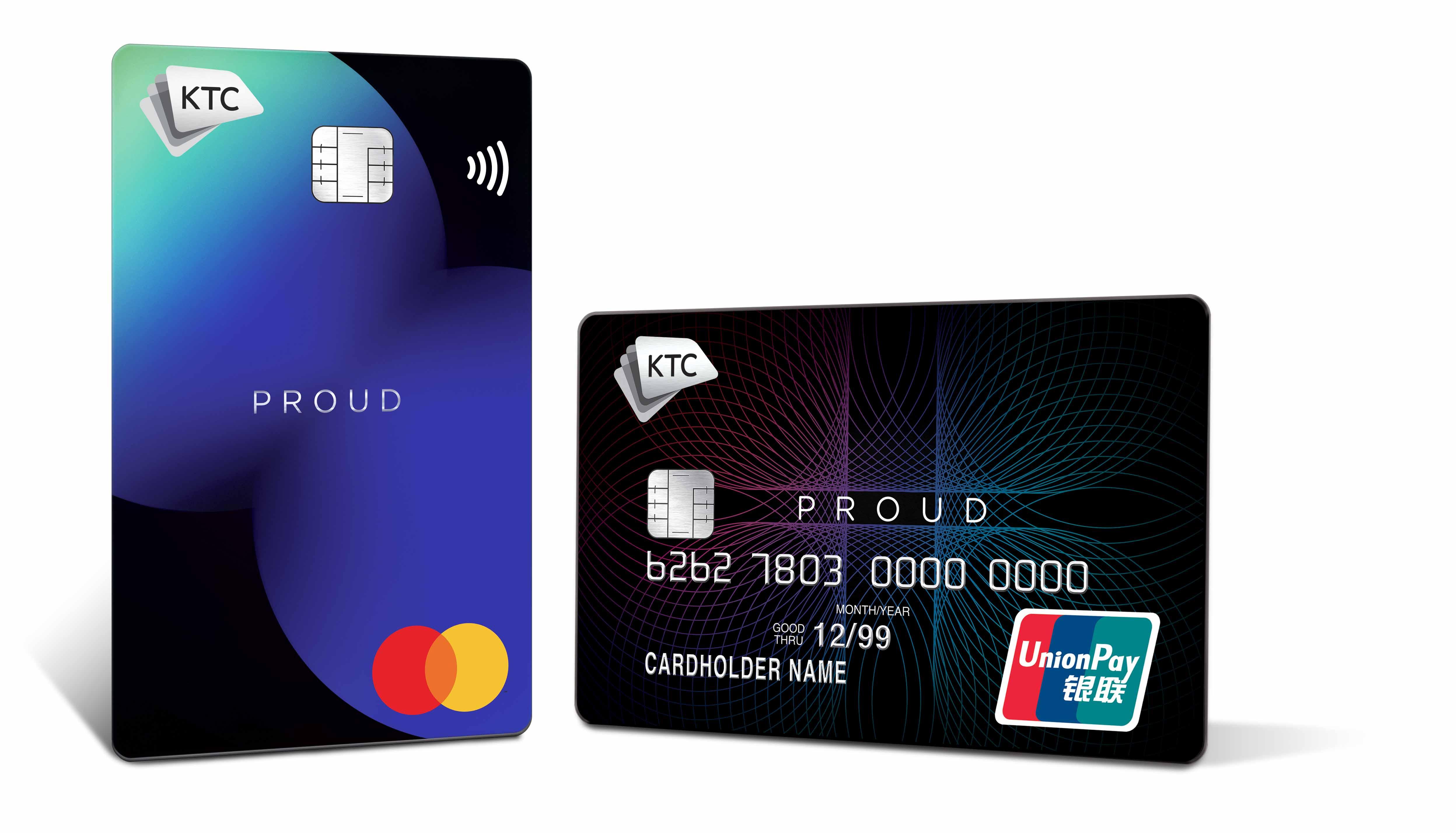
A multi-purpose loan KTC CASH was launched in October 2003. In 2006, the Company introduced a ready credit and rebranded to KTC PROUD Cash Card. In 2014, KTC PROUD Cash Card was launched as a revolving loan. KTC recognizes revenue of these personal loans based on effective interest rate, credit limit fee, and debt collection expense, etc. For personal loan business operations, the Company sets interest based on the Risk-Based Pricing method which depends on the rate specified by Bank of Thailand and uses a Credit Scoring system to process and analyse data. (A) Types of Personal Loan Services There are 2 types of KTC personal loan which are suitable for people with regular income. Customers can choose according to their needs as follows; 1.KTC Cash Personal Loan is suitable for people with an income over Baht 15,000. This type of loan offers cash. The loan is to be repaid in equal installments. Applicant gets cash in his/ her bank account within 2 days after approval. It is not a revolving credit. Installation period is ranged from 12 - 60 payments depending on approved credit limit. 2.KTC PROUD Cash Card is suitable for people with an income overBaht 12,000. It is a revolving loan. After approval, the first portion of the loan will be transferred into applicant’s bank account. It is a convenience cash card with 4 functions “Withdraw-Transfer-Swipe-Pay” in one card. Customer may swipe for purchase of goods and services at any leading merchants that support transactions with UnionPay and Mastercard cards nationwide with a 6-digit PIN to confirm the transaction for both convenience and safety. Furthermore, the card supports the Contactless Payment system that makes payments easier simply with a single touch; just simply search for the Contactless symbol on the EDC device. Customer can use the card to withdraw cash from ATM machines across the country, at “KTC TOUCH” service branches, or online on the “KTC Mobile” application or on the “KTC Online” site real-time into different bank accounts of 15 bank accounts with no cash advance fee. Moreover, customer can use the card for installment payment with 0% interest rate or special interest rate up to 24 installments, which customers can choose to pay back at least 3% of the total outstanding balance, but not less than Baht 300, at participated merchants across the country.
(B) Personal Loan Process 1.The applicant submits loan application to the Company The applicant can apply for personal loan through the same channels as credit card application and they must fill in the form provided by the Company. (Please see details about application channels in the topic “credit card service process of credit card issuing business” sub section 1) Cardholder application) 2.The Company checks applicant’s qualifications and risk profile After the application form is received, the Company will evaluate the information in the application and its supporting documents. Personal verification in accordance with the law on Counter Terrorism and Proliferation of Weapon of Mass Destruction Financing Act and personal information checking from the National Credit Bureau Co., Ltd. were conducted. The risk analysis is performed by using the Credit Scoring system and the credit analyst reviews and sets criteria, qualifications, credit limit, and interest rate, including fees according to the Bank of Thailand announcement. 3.The Company notifies application results (either approve or reject) to the applicant The Company will inform applicants of the approval or rejection of their loans request through SMS and/ or letters. If approved, a payment schedule will be provided along with the approval notification. Upon approval, the company will transfer cash to the applicant’s bank account on the same day, in the case of accounts with Krungthai Bank, Kasikorn Bank, and Bangkok Bank. For accounts with other banks, the cash will be transferred within 1 working day after approval. 4.The Company sends installment statement and collects payment from the applicant The Company will send billing statement to customer every month before the due date. The customer brings monthly statement to pay via various channels provided by the Company, such as
For more information on payment channels, please contact KTC PHONE 02 123 5000 or visit https://www.ktc.co.th/en/support 5.Follow up in case of delinquency In case customer fails to make payment within the due date, the Company will follow up the payment and offer late payment extension to customer by considering customer’s needs and rationales. Under the closely monitored risk control system, the debt collection process for this personal loan business is done the same way as the credit card business. (Please see details of Debt Collection in the topic “Process of credit card service of credit card business” sub-topic 5) Debt Collection) | ||||||||||||
| Auto Title Loan Business - KTC P BERM Car for Cash | Car registration loan business, KTC P BERM Car for Cash is a type of loan with car registration as collateral. There are 3 main products: car title loan, motorcycle title loan and big bike title loans.
The loan services provided consist of two types of loans: Installment loans and Revolving loans. The Revolving loan is offered in the form of the KTC P BERM Cash Cards, which allows customers to withdraw and access their credit limit anytime and anywhere. It can also be used to make installment payments for goods at various leading retailers. To qualify for a KTC P BERM loan, customers must pledge their vehicle registration, in which they are the registered owner, as collateral. The company will recognize income from interest charges, vehicle appraisal fees, and collection-related expenses. For auto title loan business operations, the Company offers interest based on the Risk-Based Pricing method which depends on the rate specified by the Bank of Thailand. The Company also analyses risk based on customers’ qualifications and debt repayment ability. This also includes cars or motorcycles’ qualifications that customers use as collateral. (A) Types of Auto Title Loan Business – KTC P BERM Car for Cash There are three main product types of KTC P BERM Car for Cash, which are suitable for customers of all occupations, whether they are customers with regular income, small business owner or freelancers. Customers can choose in accordance with the needs of using the credit limit or type of vehicle registration book to be placed as collateral as follows: 1.Car title Loans for individuals with earnings of Baht8,000 or more (or business owners with sales of Baht 30,000 or more).It is a loan paid in installments with equal payment amount every month. The maximum interest rate is 24% per annum. The credit limit is determined by customers’ qualifications, the age of the car, brand, model, and its conditions. It is an installment loans, which equally paid in each period. Customers can choose to receive a revolving credit line in the form of a cash card for withdrawal of money, shopping, or money transfer online via KTC mobile applications. 2.Motorcycle title loans for customers who own motorcycles registered for R.R.12 and R.R.17, of all occupations, unlimited income, with a maximum interest rate of 24% per annum. The credit line is determined based on the age, brand, model, and its conditions of the motorcycle. It is an installment loans, which equally paid in each period, and is a revolving loan that once approved, the customer receives the first transfer amount and a cash card to withdraw money, which can be swiped to buy products or transfer money online via KTC Mobile Application. 3.Big bike title loans for individuals owning the rights to big bike (engine size 250cc and above) registered with the Department of Land Transport (form R.R. 12 and R.R. 17) and having a monthly income of at least Baht 8,000 (or business owners with sales of at least Baht 30,000). The maximum interest rate is 24% per annum. The credit line is determined based on customer’s qualifications, the age of the motorcycle, brand, model, and the condition of big bike. It is an installment loans, which equally paid in each period. Customers can also opt for a revolving credit line in the form of a cash card for cash withdrawals, purchases, or money transfers online via the KTC Mobile Application. (B) Auto Title Loan “KTC P BERM Car for Cash” Process 1.The Applicant contacts the Company for loan application The applicant contacts or registers to express their needs for auto title loan by contacting the Company via the following channels;
2.The Company makes an appointment to get loan application After the Company received loan application form, a loan officer will contact applicant to process an appointment at their convenient date, time, and place so they can prepare application documents and bring the vehicle to check its condition according to the consideration processes. 3.The Company checks applicant’s qualifications, vehicle’s qualifications, and risk profile Upon submission of the application and supporting documents and after presents the vehicle for inspection at the appointed date, time, and location with the Company’s officer, the Company will evaluate the loan application based on the provide information and its supporting documents. This evaluation will include verifying the applicant’s status in accordance with the law on Counter Terrorism and Proliferation of Weapon of Mass Destruction Financing Act, conducting a credit history check with the National Credit Bureau Co., Ltd., and assessing the applicant’s risk profile in alignment with responsible lending principles, alongside with a collateral vehicle’s qualifications according to the Company’s terms and conditions. The credit limit, interest rate, including fee are set according to the Bank of Thailand Regulations and Notification. 4.The Company notifies application results (either approve or reject) to the applicant The Company notifies credit limit approval or reject to grant credit to the applicant as soon as the consideration result is finalized through the Company’s representatives who taking care of the application. Once the application is approved, the Company will prepare a loan contract with enclosed table showing installment payment amount. And when the contract is signed by the applicant, the Company will transfer cash to the applicant’s Krungthai bank account within the day of approval, or to an account at another bank by the following day. 5.The Company sends Payment Card to customers The Company will send the Payment card to customer within 7 days after the loan is approved so customer can use the card for loan payment via various payment channels provided by the Company as follows;
6.Follow up in case of delinquency In case customer fails to make payment within the due date, the Company will follow up the payment and offer late payment extension to customer by considering customer’s needs and rationales. Under the closely monitored risk control system, the debt collection process for this personal loan business is done the same way as the credit card business. (Please see details of Debt Collection in the topic “Process of credit card service of credit card business” sub-topic 5 Debt Collection) | ||||||||||||
| Business of Subsidiaries (which are KTB Leasing Company Limited/ KTC Nano Company Limited/ KTC Prepard Company Limited | KTB Leasing Company Limited Operates in the retail personal loan business for occupational purposes, specifically providing Hire Purchase and Financial Lease services. Since August 2023, the company has implemented a policy to cease new lending in these categories. Its current operations are focused solely on debt collection and managing the quality of the existing loan portfolio. KTC Nano Company Limited Providing retail personal loans for professional use. Due to elevated household debt, and an increasing trend of non-performing loans, the Company is currently in the process of studying business opportunities in the Nano finance business. KTC Prepaid Company Limited Operates regulated payment services, including e-money issuance, electronic funds transfer services, and payment services. On January 9, 2026, KTC Prepaid Company Limited (“KTCP”) was granted approval by the Bank of Thailand to return its business license. The company is currently undergoing the legal dissolution process, which is expected to be completed within the second quarter of 2026. The dissolution will not have any impact on KTC’s operating results or financial position. |

Research & Development
Has R&D Policy (Y/N)
No
R&D Cost — Label
Research and development (R&D) expenses over the past 3 years (Million Baht)
R&D Cost — This Year
0.0
R&D Cost — Last Year
0.0
R&D Cost — 2 Years Ago
0.0
Assets Used in the Business
Permanent Assets — Description
Please refer to additional details under the “Assets for Business Operations” topic.
Intangible Assets — Description
Please refer to additional details under the “Assets for Business Operations” topic.
Has Subsidiaries Investment Policy (Y/N)
Yes
Subsidiaries Investment Policy — Description
Please refer to additional details under the “Corporate Governance Policy” topic.
Marketing Policy & Competition
Reporting Mode
3117
Marketing Policy (Overall)
Marketing policies of the major products or services during year 2025
Credit Cards
In 2025, the Company targets 10% growth in credit card spending, focusing on customers with monthly income of Baht 50,000 and above and first-jobbers. Under the “Maximize Growth Opportunity” strategy, the company will drive growth through digital transformation and Data-Driven Marketing, alongside the expansion of business partnerships, to achieve sustainable growth, with details as follows.
1.The company aims to maintain its position as the market leader with the highest active portfolio by leveraging Data-Driven Marketing to enhance precision in Market Segmentation, ranging from new customer acquisition to the delivery of tailored benefits that accurately address the needs of each customer segment. Additionally, there are plans to incorporate Alternative Data into the credit approval process.
2.Leveraging digital transformation to elevate marketing effectiveness across the entire customer journey.
Apply Online Service: An online application channel that enables customers to apply for credit cards independently.
KTC Digital Credit Card: The issuance of KTC Digital Credit Card specifically designed to cater to the Higher-Income segment.
KTC Mobile Application: Continuous development of the app as the primary service tool for cardmembers, offering Personalized promotions tailored to individual preferences.
3.Strategic Marketing Differentiation through Loyalty Programs via collaboration with business partners, the company will enhance its Loyalty Program to reward consistent card spending. The primary focus will be on key lifestyle categories, including Dining, Shopping, and Travel.
4.Advancing KTC Digital Communication by expanding its communication channels via LINE Connect to reach customers more effectively through Personalized Marketing. Simultaneously, the company is developing a Customer Data Platform (CDP), a vital tool for comprehensive customer data management. This platform enhances the precision of Customer Segmentation and ensures streamlined communication by reducing redundancy.
Personal Loan
In 2025, the personal loan business, “KTC PROUD” Cash Card, targets 3% growth, with a strategic focus on expanding the new member base through various business partnerships. This will enhance customer access to credit via the online loan application channel (E-Application), enabling customers to complete applications independently, receive an approval result, and obtain fund transfers to their bank accounts within 30 minutes. In parallel, the Company aims to enhance the customer experience through the “Swipe, Transfer, Withdraw, and Installment” all-in-one functionality, and to continue the “Debt Clearance” program to strengthen customers’ financial discipline.
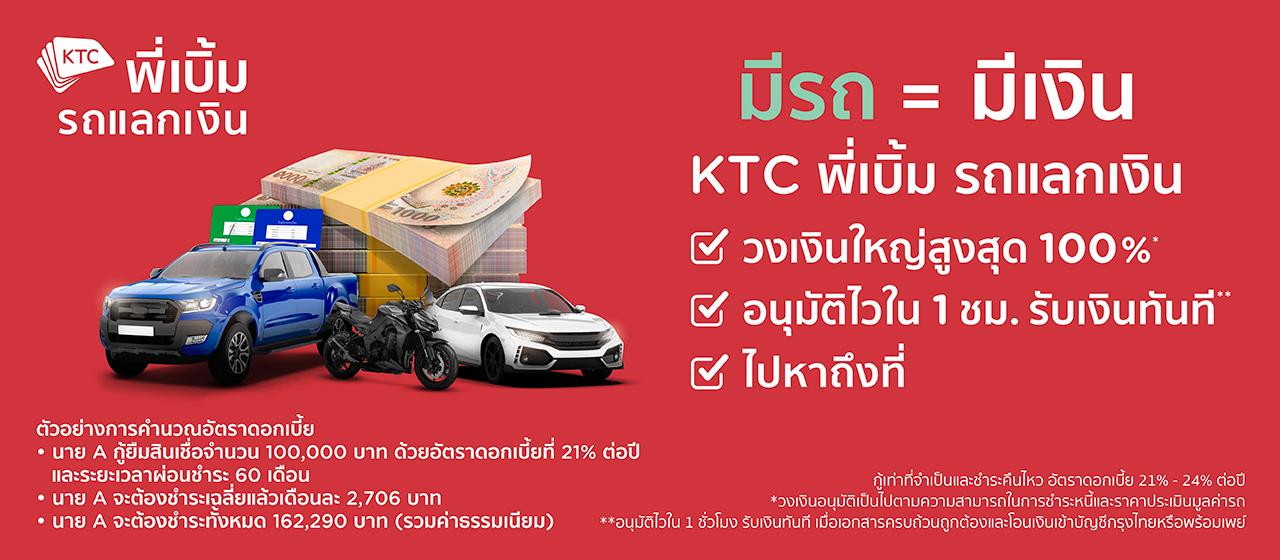
For the "KTC P BERM Car for Cash", the company has set a growth target of Baht 3 billion, with a focus on expanding a high-quality loan portfolio through Krungthai Bank branches. The strategy targets customers with salaried individuals and small entrepreneurs who own cars or motorcycles and are seeking easy and secure access to formal financing. Key value propositions include a maximum credit limit of up to 100% of the appraised value, fast approval within 1 hour, and immediate fund disbursement—all with no guarantor required.
Marketing policies of the major products or services during year 2026
Credit Cards
In 2026, the Company targets 5% growth in credit card spending, alongside a plan to acquire 250,000 new members, from the current base of approximately 2.3 million members, with a total of 2.9 million credit cards in circulation. These initiatives will be driven by four key strategic pillars, as follows:
1.Strengthening the quality of the member portfolio by enhancing products and improving the efficiency of member acquisition through digital channels, while offering benefits that align with lifestyle needs in dining, shopping, and travel, as well as categories that reflect emerging customer interests, such as wellness and healthcare.
2.Expanding the insurance brokerage business through strategic collaborations with partners, to develop life and non-life insurance products, providing members with more diverse and valuable options while generating new revenue streams from insurance products through credit card channels.
3.Synergizing growth with Krungthai Bank, focusing on three core target segments: the Wealth Segment, by elevating exclusive privileges and providing more comprehensive services; SME Segment, by creating opportunities for merchant partners via the "KTC U SHOP" e-marketplace, which is being rebrand as "KTC MALL.", and the Gen Z Segment, by targeting university students to establish a new member base from the early stages of their purchasing power.
4.Leveraging digital and AI technologies to drive marketing strategies, enhancing the customer experience to be seamless, fast, and effortless, while delivering highly accurate personalized benefits.
Personal Loan
In 2026, amid an anticipated economic slowdown, KTC’s personal loan prioritizes maintaining and controlling asset quality as a core strategy. The business targets 2% growth, emphasizing high-quality portfolio expansion, and plans to acquire 110,000 new KTC PROUD cash card members through four key marketing strategies:
1.Enhancing the online E-Application by integrating it into the KTC Mobile Application to provide greater convenience and speed, enabling customers to submit applications and receive approval results within 30 minutes.
2.Expanding the new member base through partnerships with over 2,000 high-demand merchant locations, enabling customers to scan and apply at participating stores, receive approval, and obtain products immediately. Furthermore, we are also strengthening our collaboration with Krungthai Bank by leveraging payroll-based customer data.
3.Supporting over 700,000 existing members with the “Swipe, Transfer, Withdraw, and Installments” features to accommodate all lifestyle needs. Additionally, the company will continue the “Debt Clearing” project to promote disciplined payment behavior.
4.Easing customers’ financial burdens through promotional 0% interest installment plans for up to 24 months.
For “KTC P BERM Car for Cash,” an auto title loan business, the primary strategy is focusing on expanding the member base through Krungthai Bank's network. Furthermore, the company plans to reposition and refine the product to better align with the evolving needs of the target audience.
Industry & Competition (Overall)
The Overview of Consumer Finance Industry
The Office of the National Economic and Social Development Council (NESDC) reported that Thailand’s economy grew by 2.4% in 2025, down from 2.9% in 2024, mainly due to slower private and public spending. Nevertheless, overall economic activity remained supported by robust merchandise exports, a recovery in private sector investment, and stronger public investment.
In 2026, Thailand’s economy is forecast to expand by 1.5%–2.5%, with a midpoint estimate of 2.0%. The outlook is subject to considerable downside risks, particularly in the export and manufacturing sectors, which remain highly exposed to U.S. tariff measures, global economic uncertainty, rapid technological transformation, and persistent geopolitical tensions. On the positive side, growth is expected to be supported by the continued rebound in tourism, accelerated public investment disbursement, and resilient private consumption underpinned by stable employment conditions. Nevertheless, structural vulnerabilities persist, notably elevated household debt and tight credit underwriting standards. These factors continue to weigh on consumer sentiment, constrain credit demand, and limit liquidity access for lower-income groups. Against a backdrop of political uncertainty during the government transition, these pressures have contributed to a deceleration in the overall consumer finance industry.
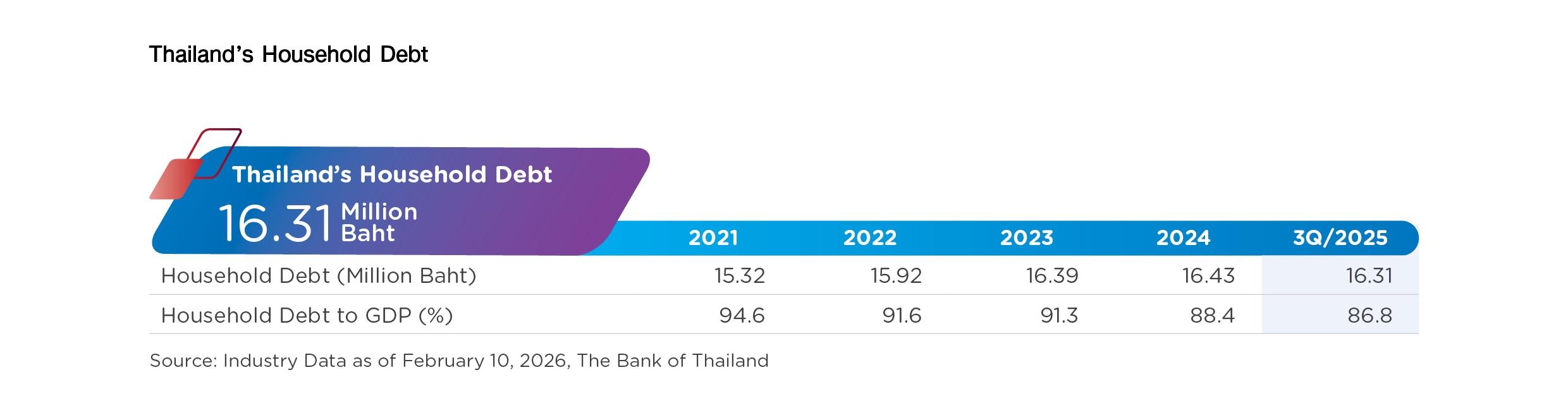
As of the third quarter of 2025, Thailand’s household debt stood at THB 16.31 trillion, a slight decrease from THB 16.43 trillion at the end of 2024, representing a decline of approximately 0.7%. Correspondingly, the household debt-to-GDP ratio fell to 86.8% by the end of the third quarter of 2025, compared with 88.4% at year-end 2024.
Although the household debt-to-GDP ratio has exhibited a downward trajectory, consistent with the deceleration in outstanding debt balances within the financial system, this development primarily reflects the fragile macroeconomic environment, income volatility, and persistently elevated cost-of-living pressures. Under these conditions, households’ capacity to incur additional debt has remained constrained. Certain borrower segments have accordingly adjusted their financial behavior by deferring discretionary borrowing and prioritizing the repayment of existing obligations over new credit uptake. Concurrently, more stringent underwriting standards for new loan origination have been implemented to preserve asset quality and mitigate non-performing loan risks, in alignment with the responsible lending framework prescribed by the Bank of Thailand, which underscores borrowers’ demonstrable debt-servicing capacity. These efforts have been further reinforced through ongoing portfolio quality enhancement measures, including structured debt restructuring initiatives and the systematic write-off of non-performing loans.
Notwithstanding the recent moderation, Thailand’s household debt-to-GDP ratio remains elevated relative to the prudential benchmark established by the Bank for International Settlements (BIS), which identifies 80% of GDP as a sustainable threshold. Sustained levels of household indebtedness above this benchmark may pose structural risks to long-term economic growth and could adversely affect overall financial system stability.
Thailand’s elevated household debt constitutes a structural economic vulnerability, largely arising from subdued income growth that has lagged behind household expenditures among certain segments, widening financial inequality and constrained access to funding sources, as well as persistently high levels of consumption-driven borrowing. Such elevated debt burdens limit households’ capacity to assume additional credit and erode their ability to service existing obligations. Consequently, the ratio of non-performing loans (NPLs) is projected to continue trending upward.
In this regard, the Bank of Thailand has introduced sustainable measures to address household debt through the Responsible Lending (RL) framework. This framework mandates that financial institutions provide comprehensive support—ranging from rigorous repayment capacity evaluations to debt restructuring—both before and after loans become non-performing. The primary objective is to facilitate genuine debt resolution, particularly for those facing chronic debt. In parallel, targeted relief continues through the 'You Fight, We Help' program (Phases 1 and 2), supporting retail debtors and SMEs. Most recently, in late 2025, the Ministry of Finance, in collaboration with the Bank of Thailand and financial institutions, launched the 'Clear Debt, Move Forward' initiative. This special mechanism proactively addresses non-performing loans (NPLs) via debt purchase through Asset Management Companies (AMCs). It specifically targets unsecured retail borrowers with total credit limits not exceeding THB 100,000 as of September 30, 2025, aiming to clear systemic bad debt and reintegrate borrowers into the formal economy.
The prevailing household debt burden, as previously discussed, has posed material risks to both macroeconomic stability and financial system integrity, thereby limiting the scope and effectiveness of policy measures aimed at maintaining economic equilibrium. In light of these challenges, it is imperative to foster integrated and sustained collaboration among all relevant stakeholders—including government agencies, private sector participants, and financial institutions—to ensure that household debt mitigation strategies are comprehensive, durable, and outcome-oriented. Through such coordinated and multi-sectoral efforts, the financial soundness and resilience of households can be strengthened, forming a critical underpinning for the advancement of a stable, resilient, and sustainable economy in the long term.
1.Overview of Credit Card Industry
(1) Competition and Competitors in the Credit Card Business
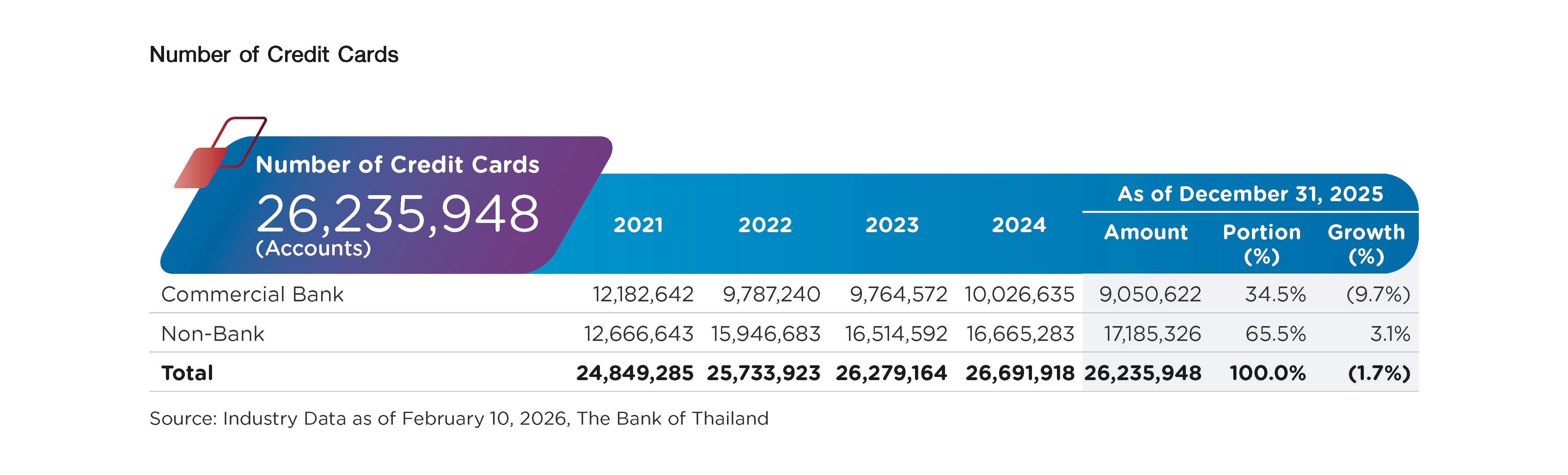
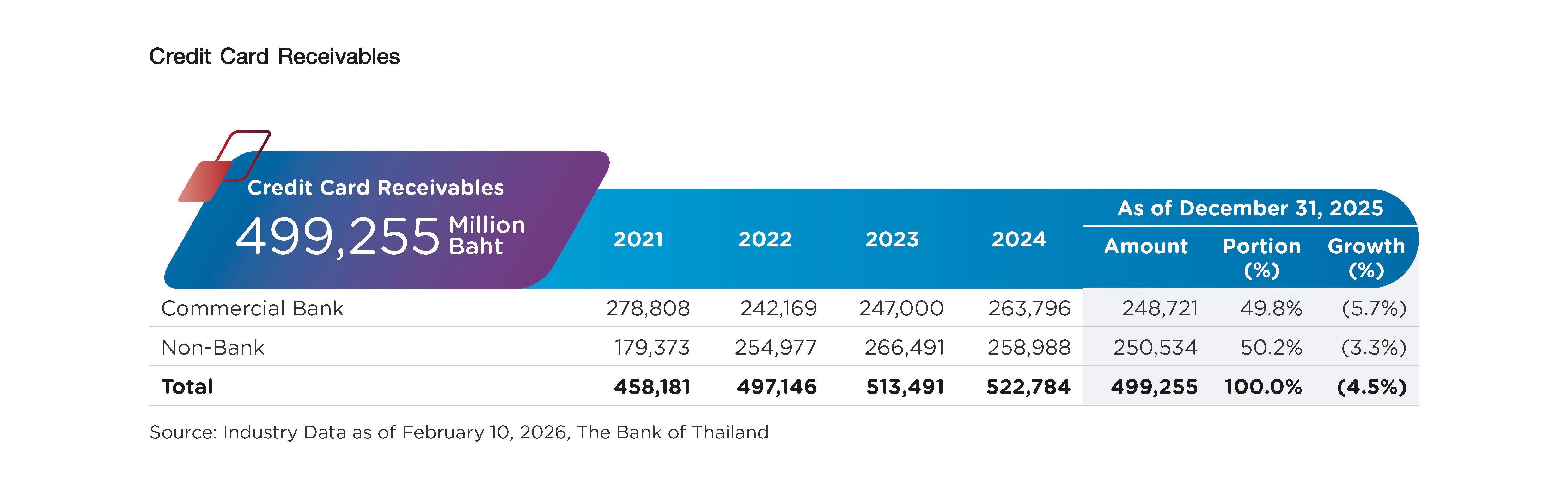
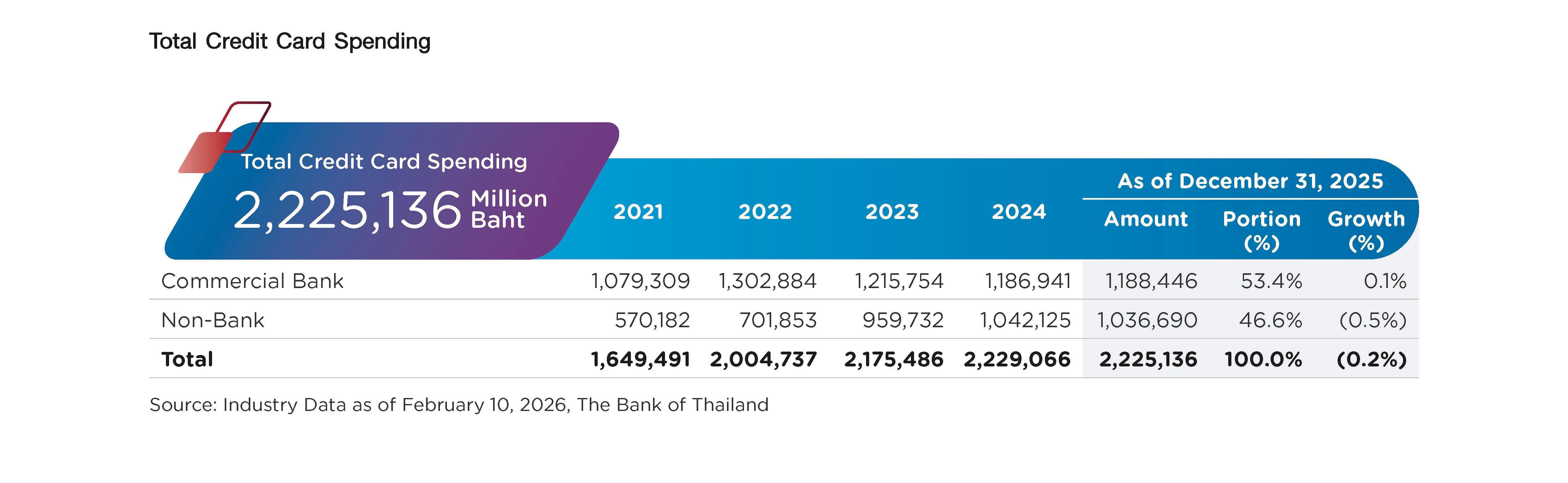
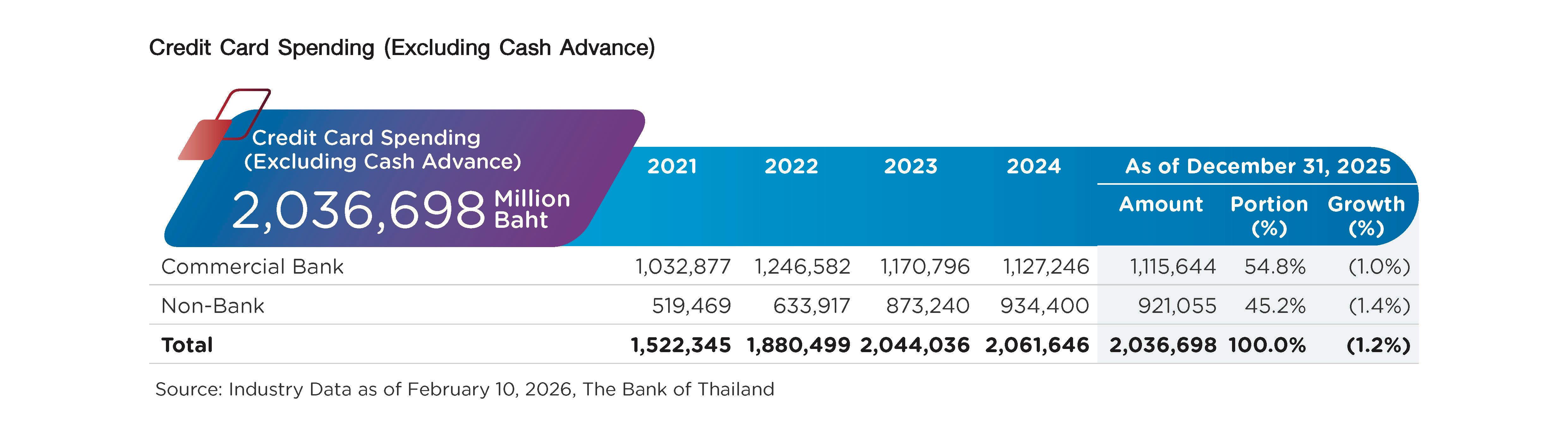
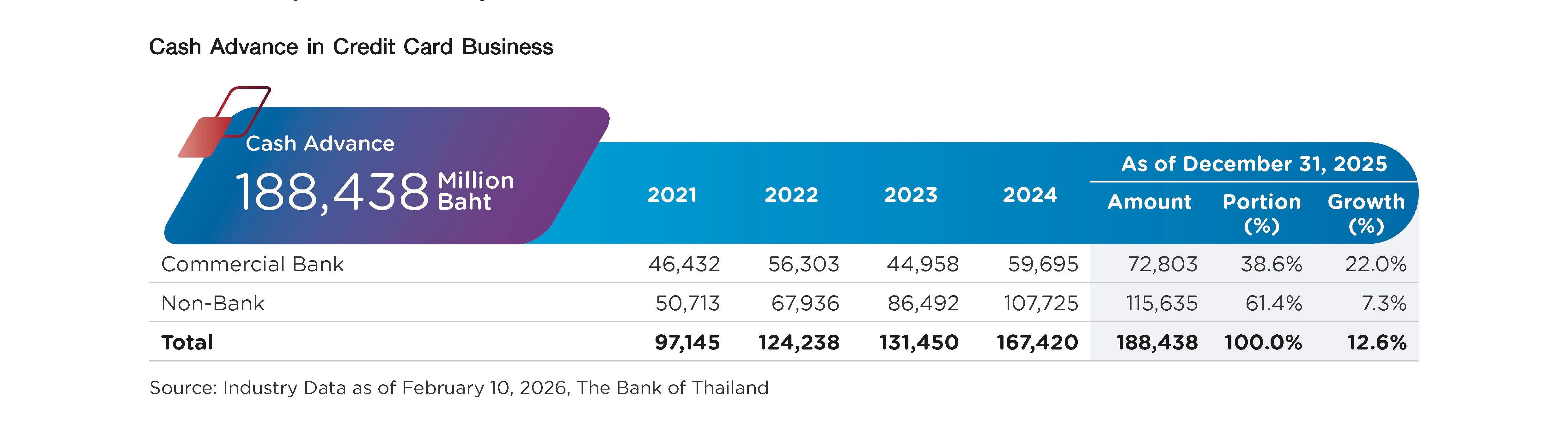
As of 31 December 2025, industry data indicate that the total number of credit card accounts declined by 1.7%, compared with a growth rate of 1.6% in 2024, primarily reflecting more prudent credit expansion policies and stricter approval criteria for new card issuance aimed at containing non-performing loans. Outstanding credit card balances contracted by 4.5%, reversing the 1.8% growth recorded in the prior year. Credit card spending, excluding cash advances, decreased by 1.2% compared with growth of 2.5% in 2024, while cash advance volumes increased by 12.6%, representing a marked deceleration from the 27.4% expansion recorded a year earlier. Overall, loan growth within the credit card industry has moderated significantly. This deceleration reflects the gradual recovery of domestic purchasing power and persistently elevated household debt levels. Concurrently, operators have strengthened credit underwriting and approval standards, with greater emphasis on maintaining portfolio quality and mitigating the risk of higher loan loss provisioning expenses.
Concurrently, the credit card industry remains subject to heightened competitive pressures, as operators intensify efforts to broaden their customer base and enhance market share. Over the past year, industry data indicate that non-bank institutions have further consolidated their market position, capturing a proportion of outstanding loan balances comparable to that of commercial banks. This performance underscores their capability to address evolving consumer demands through flexible product structures and proactive, targeted marketing initiatives. Since 2022, non-bank operators have progressively established a leading position across several key metrics. In terms of cards in circulation, non-bank institutions account for approximately 65% of the total, significantly exceeding the share held by commercial banks. This reflects their extensive penetration into retail customer segments and highlights the sustained intensity of competition within the credit card industry.
Against the backdrop of intensifying competition and prevailing economic headwinds, credit card companies have expedited strategic realignments to better respond to evolving consumer behaviors and stimulate spending activity. Core initiatives include investments in technological enhancements and payment innovations associated with credit cards and new financial solutions, expansion into medium- to high-income customer segments, and growth through strategic partnerships at both domestic and international levels. Operators have also intensified competition in card privileges and value-added benefits, including exclusive promotions, reward programs, cashback schemes, and merchant discounts. These strategic efforts are pursued in parallel with a continued focus on preserving asset quality, adhering to responsible lending principles, and strengthening portfolio risk management frameworks to mitigate default risk. Simultaneously, the industry faces ongoing challenges from emerging financial innovations that are increasingly capturing market share within the payments ecosystem, representing critical competitive dynamics that require close monitoring by industry participants.
Notwithstanding prevailing challenges, the expected gradual recovery of the economy is projected to serve as a structural growth catalyst for the credit card industry, reinforcing its medium- to long-term expansion trajectory. This outlook is supported by a prospective increase in credit demand, consistent with rising household consumption requirements and a progressive strengthening of consumer confidence.
As of 31 December 2025, the total number of credit card accounts in the system stood at 26.2 million, representing a contraction of 1.7%. This trend was consistent with the total outstanding credit card loans across the industry, which amounted to THB 499,255 million, declining by 4.5% compared to the end of the previous year. Total industry card spending reached THB 2,225,136 million, reflecting a slight decrease of 0.2%. Further details of the industry data are presented in the table below.
(2) Comparison of Company’s Credit Card Business to the Industry
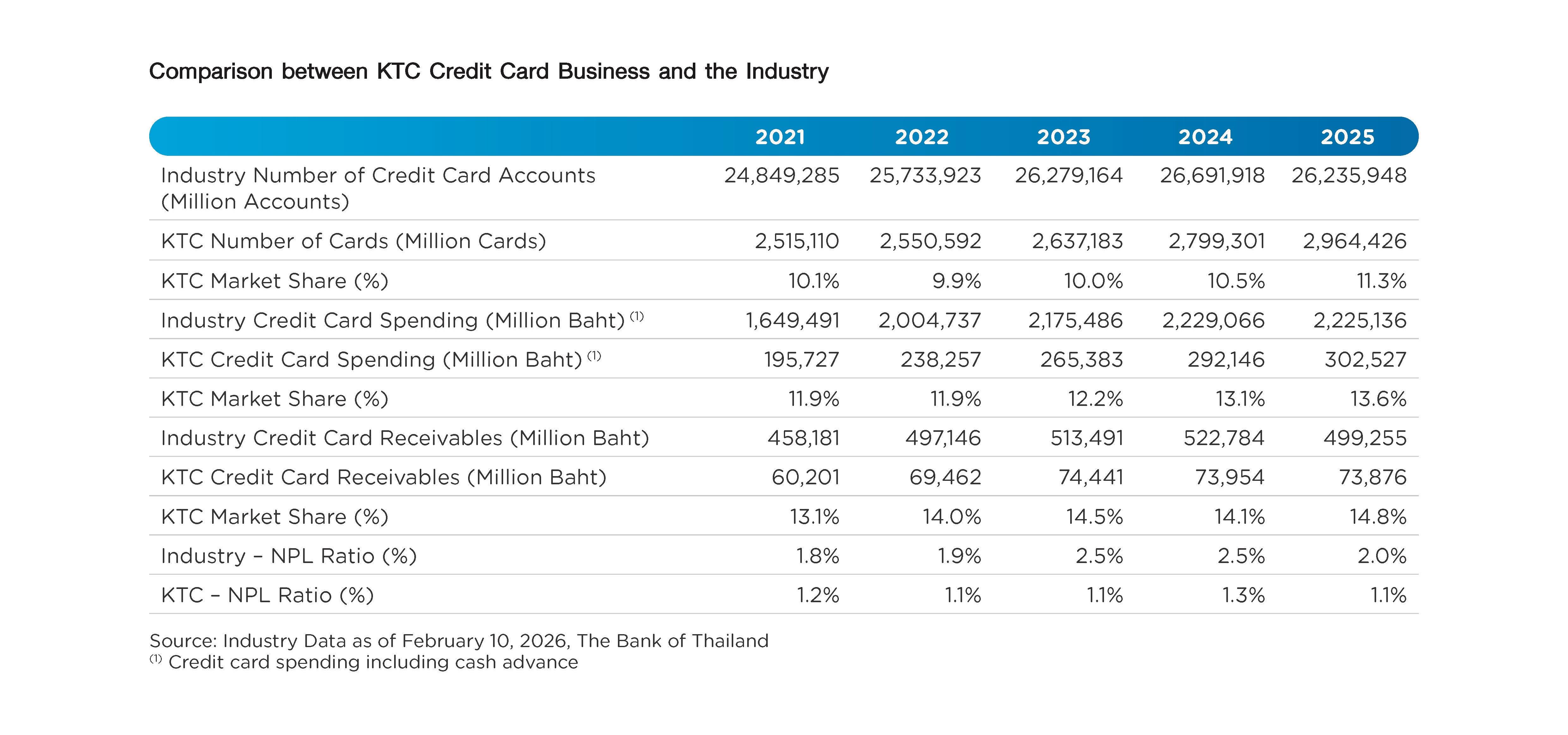
A comparison between the Company’s credit card performance and overall industry trends indicates that the Company generated total credit card spending of THB 302,527 million in 2025, up from THB 292,146 million in the previous year, representing growth of 3.6%. In contrast, aggregate industry credit card spending declined by 0.2% over the same period. As a result, the Company achieved a market share of 13.6% in terms of card spending.
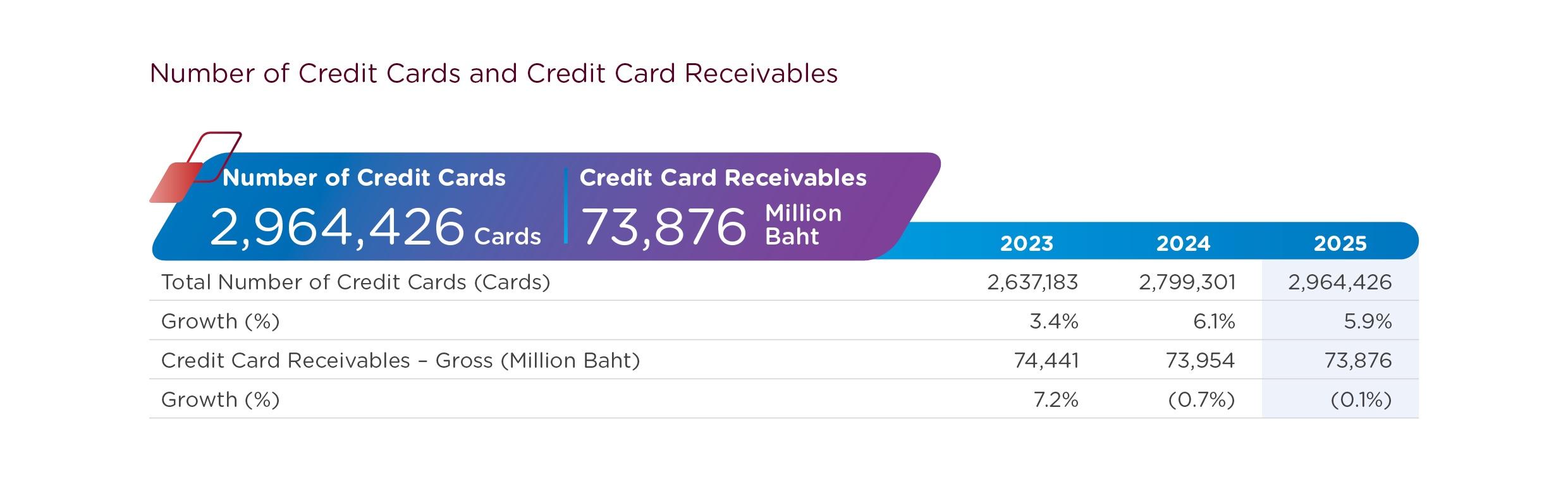
In terms of credit card receivables, as of 31 December 2025, the Company’s outstanding balance amounted to THB 73,876 million, reflecting a slight decline of 0.1%. Meanwhile, total industry receivables contracted by 4.5%, with the Company maintaining a market share of 14.8%.
The Company has strengthened its cardholder base through strategic collaborations with Visa, Mastercard, JCB, and UnionPay. In parallel, it has rolled out targeted spending stimulation initiatives across diverse product and service categories that align with members’ lifestyles, while continuously cultivating new partnerships to broaden value-added privileges in emerging segments. As of year-end 2025, the Company had 3.0 million credit card accounts, representing a market share of 11.3%.
As of 31 December 2025, the industry-wide non-performing loan (NPL) ratio declined to 2.0%, compared with 2.5% in 2024. By provider segment, commercial banks reported an NPL ratio of 2.2%, while non-bank credit card institutions recorded a lower ratio of 1.8% in 2025. The overall downward trend in the industry’s NPL ratio reflects the adoption of more disciplined lending practices, enhanced credit screening standards, proactive portfolio monitoring, and the implementation of targeted debt relief measures for borrowers. Consequently, asset quality across the industry has strengthened. As of the same date, KTC’s NPL ratio stood at 1.1%, remaining below the industry average.
2.The Personal Loan Industry Overview
(1) Competition and Competitors in the Personal Loan Business
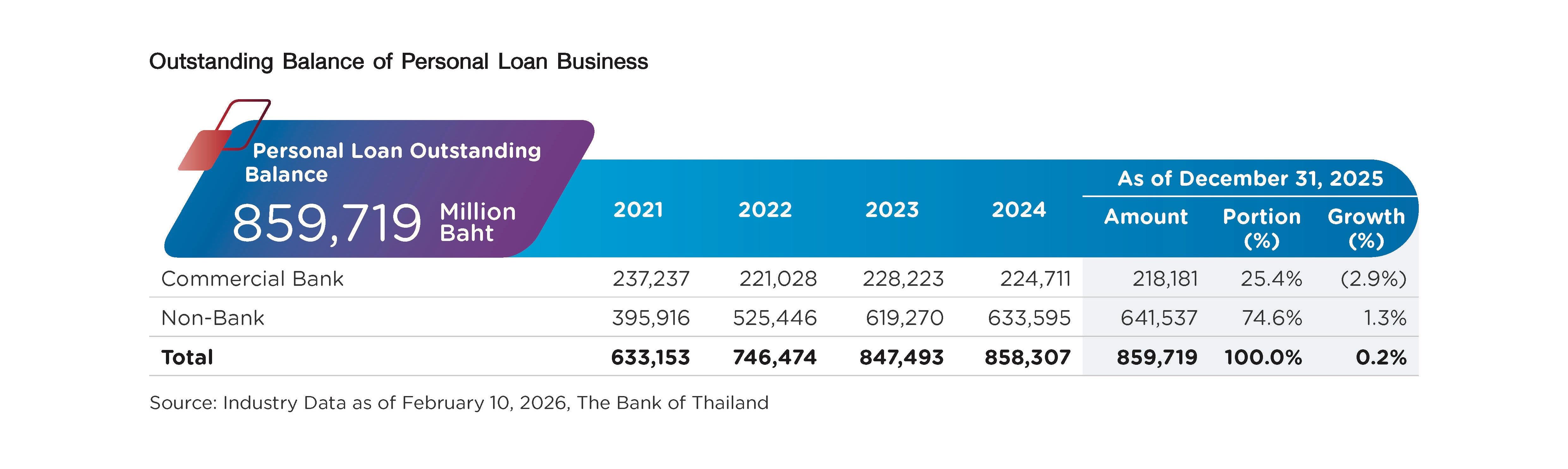
In 2025, the overall personal loan business under supervision experienced slower growth in line with economic conditions, as borrowers’ capacity to take on new debt remained constrained due to a continued decline in repayment ability. Nevertheless, the personal loan business continues to face challenges in maintaining asset quality, resulting in stricter lending standards.
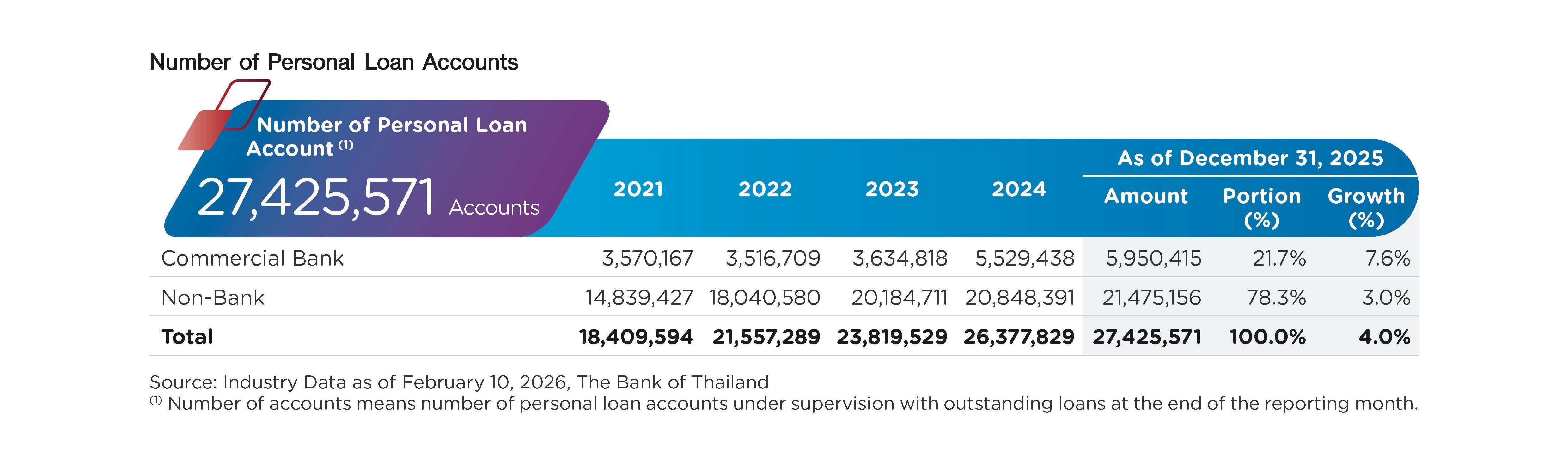
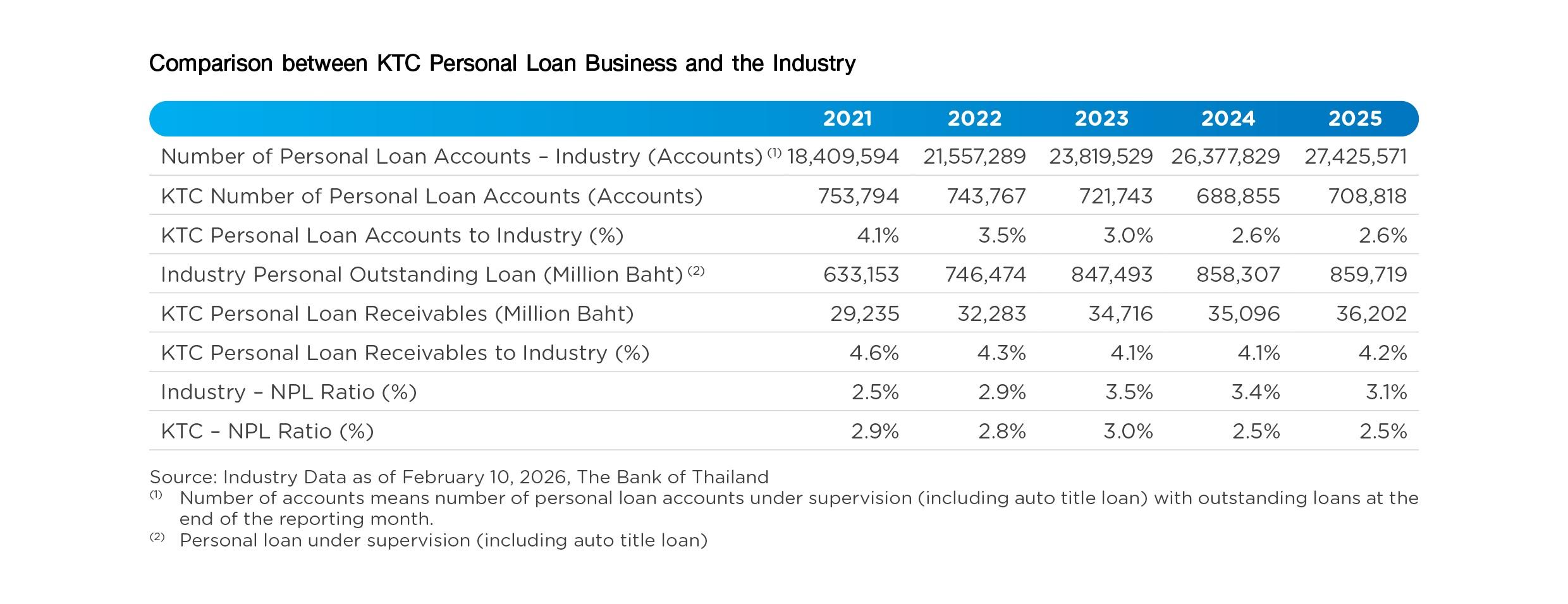
As of 31 December 2025, the total number of personal loan accounts across the industry reached 27.4 million, reflecting a year-on-year increase of 4.0% from 26.4 million accounts in the corresponding period of the previous year. Despite this expansion, competition within the personal loan segment remains intense, given its relatively high-margin profile, which continues to attract participation from a broad range of market players. Additional details of the industry data are provided in the table below.
(2) Comparison of Company's Personal Loan Business with the Industry
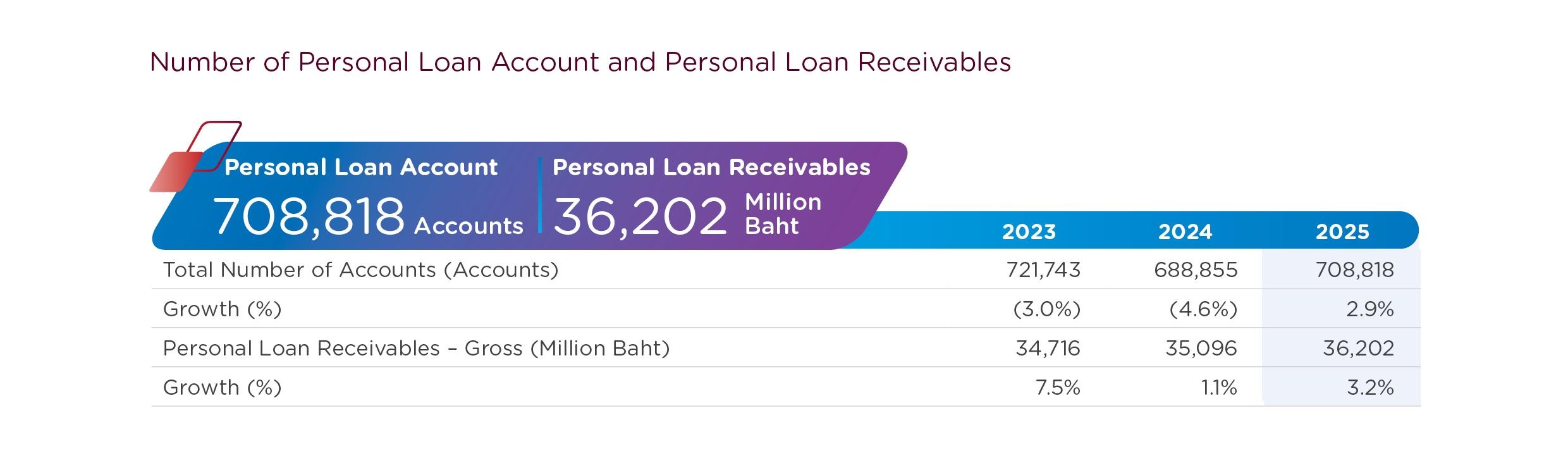
As of 31 December 2025, KTC maintained 708,818 personal loan accounts, representing a year-on-year increase of 2.9%, compared with overall industry growth of 4.0%. The Company’s market share in terms of personal loan accounts stood at 2.6% in 2025. Outstanding personal loan receivables as of year-end 2025 totaled THB 36,202 million, reflecting growth of 3.2% and corresponding to a market share of 4.2%. Notwithstanding prevailing competitive pressures, the Company remains focused on expanding its new customer base by targeting high-potential segments, leveraging strategic partnerships to acquire new members, and enhancing credit accessibility through digital channels, including E-Application platforms that enable customers to complete the application process independently. Concurrently, the Company continues to prioritize the preservation of strong portfolio quality.
Regarding asset quality in the personal loan portfolio, the industry-wide non-performing loan (NPL) ratio in 2025 stood at 3.1%, decreasing from 3.4% in the previous year. Meanwhile, the Company’s NPL ratio was 2.5%, remaining broadly in line with the level recorded at the end of 2024. Nevertheless, the Company continues to prioritize disciplined portfolio quality management, adjusting its strategies in response to prevailing conditions while maintaining a prudent approach to credit expansion.
Procurement of Products & Services
Reporting Mode
3117
Procurement (Overall)
Credit card acquisition
As the Company needs to obtain plastic card to produce various kinds of credit cards, along with store cardholder’s data into both microchips embedded in front of the card and magnetic stripe at the back, the Company has decided to use outsource service providers certified by Visa, Mastercard, JCB, and UnionPay. The entire processes of credit card production are as follows:
Blank Card ordering: outsource service providers will manufacture plastic cards according to the amount and the formats that the Company has ordered in which each order will be estimated for sufficient use. When plastic cards in inventory reach a reorder point, the Company will make additional order to ensure that outsource service providers can produce cards in time.
Embossing or applying drops on demand and recording data in magnetic stripes and microchips: plastic card will be embossed with cardholder’s name and surname according to the format or type of the credit card that cardholder chooses. Cardholder’s data will also be stored into microchips and magnetic stripes with outsource service providers’ manufacturing standards certified by Visa, Mastercard, JCB and UnionPay.
Credit card packaging and delivering to cardholders: manufactured credit card will be filled in the envelope containing a QR Code. Cardholders can scan the code to access the terms and conditions of card usage, available privileges, and QR Code to download the KTC Mobile application. The Company will deliver the credit cards via the channel selected by the cardholder, which may include postal delivery to the specified address, or delivery to KTC TOUCH, or a KTB branch as designated by the cardholder.
Procurement of EDC device/ credit card reader
The Company procures EDC devices/ credit card readers for every merchant that meets approval criteria by leasing these devices from selected equipment distributors. These distributors must have well-known, modern products that can accommodate new payment technologies and conform to international payment and data security standards. Moreover, the Company also has a policy relating to after-sales service level. Therefore, it must carefully select services offered by distributors that have stable business with professional management and capable teams as well as nationwide distribution and service networks, which can ensure that they will be able to maintain a service level that the Company is committed to provide to its merchants’ members. The purpose is to provide fast services to merchants and minimize opportunities to commit frauds by merchants’ members.
Source of fund
The Group procured funds from two primary sources, namely shareholders’ equity and liabilities. As of December 31, 2025, the shareholders’ equity of the Group amounted to Baht 44,019 million, comprising paid-up share capital of Baht 2,578 million, ordinary share premium of Baht 1,892 million, and retained earnings (appropriated retained earnings required by law and unappropriated retained earnings) of Baht 39,258 million. Furthermore, the Group has surplus on business combination under common control and other components of equity amounted of Baht 424 million, and a deficit in non-controlling interests of Baht 133 million. Moreover, total liabilities amounted to Baht 66,505 million.
Regarding the sources of liabilities, the Group’s total borrowings amounted to Baht 57,140 million, including lease liabilities. The funding mix is weighed toward long term borrowings, which account for 52 percent, while short term borrowings, comprising loans and debentures maturing within one year, represent 48 percent. KTC’s funding sources are drawn from a wide range of counterparties, spanning Thai commercial banks, securities firms, insurance companies, and investment funds. These comprise short-term borrowings from Krungthai Bank and related parties of Baht 4,100 million; short-term borrowings from other financial institutions of Baht 7,200 million; long-term borrowings from Krungthai Bank of Baht 10,000 million; and debentures totaling Baht 35,612 million. Debentures account for approximately 62% of total borrowings, underscoring strong investor confidence and the Company’s proven access to the domestic debt capital market.
Nature of Business — Overview
Introduction
Krungthai Card Public Company Limited engages primarily in the credit card business, including related services such as merchant acquiring, payment services, and personal loans. Its lending portfolio covers regulated personal loans and auto title loans. The Company has also established subsidiaries to broaden its financial product offerings, encompassing nano finance for occupational purposes, hire purchase, and leasing businesses.
Projects Under Construction
Has Projects Under Construction (Y/N)
No
Debentures & Bills of Exchange
Introduction
The Company procured funds from two primary sources, namely shareholders’ equity and liabilities. As of December 31, 2025, the shareholders’ equity of the Company amounted to Baht 44,019 million, comprising of Baht 2,578 million in paid-up share capital, ordinary share premium of Baht 1,892 million, surplus on business combination under common control and other components of equity of Baht 424 million, retained earnings (appropriated retained earnings required by law and unappropriated retained earnings) of Baht 39,258 million, and non-controlling interests of Baht -133 million. Total liabilities amounted to Baht 66,505 million. At the end of 2025, the Group had a total short-term credit line from financial institutions in the amount of Baht 31,740 million (including a Baht 18,030 million credit line from Krungthai Bank). Out of this amount, Baht 11,270 million of short-term credit lines were utilized, leaving a remaining balance of Baht 20,470 million.
As of the end of 2025, the Group’s total borrowings amounted to Baht 57,140 million (including lease liabilities of Baht 228 million), representing a decrease of 8.3% (YoY). The capital structure comprised 48% short-term borrowings (including the portion of long-term loans and debentures due within one year) and 52% long-term borrowings. KTC possesses diversified funding sources, including Thai commercial banks, securities companies, insurance companies, and various funds, categorized as follows:
The total value of long-term loans from Krungthai Bank that have not yet reached maturity amounted to Baht 10,000 million, with interest rates based on the Capital Market Rate.
The total value of bills of exchange arising from short-term borrowings from financial institutions that have not yet reached maturity amounted to Baht 11,300 million. This consists of short-term loans from financial institutions and related persons of Baht 4,100 million and other financial institutions of Baht 7,200 million, with interest rates based on the Money Market Rate.
The total value of debentures that have not yet reached maturity amounted to Baht 35,612 million. All debentures are unsecured and have been assigned a credit rating of “AA-” by TRIS Rating Co., Ltd., with details as follows:
Has Debentures (Y/N)
Yes
Debentures
| Debenture Name | Description / Rating | Interest Rate (%) | Outstanding | Maturity Date | Term | Types |
|---|---|---|---|---|---|---|
| DEBENTURES OF KRUNGTHAI CARD PUBLIC COMPANY LIMITED NO. 1/2016 SERIES I DUE 2026 | Private Placement to no more than 10 investors (PP-10). | 3.85 | 200 | 17 February 2026 | 10 Years | 2789 · Description: Senior Debenture · 2791 · Description: Unsecured Debenture |
| DEBENTURES OF KRUNGTHAI CARD PUBLIC COMPANY LIMITED NO. 1/2016 SERIES II DUE 2026 | Private Placement to no more than 10 investors (PP-10). | 3.85 | 300 | 17 February 2026 | 10 Years | 2789 · Description: Senior Debenture · 2791 · Description: Unsecured Debenture |
| DEBENTURES OF KRUNGTHAI CARD PUBLIC COMPANY LIMITED NO. 7/2016 DUE 2026 | Private Placement to no more than 10 investors (PP-10). | 3.5 | 200 | 22 September 2026 | 10 Years | 2789 · Description: Senior Debenture · 2791 · Description: Unsecured Debenture |
| DEBENTURES OF KRUNGTHAI CARD PUBLIC COMPANY LIMITED NO. 8/2016 SERIES III DUE 2026 | The debentures were offered to institutional and/or high net worth investors. The proceeds were intended for the company’s business operations and expansion, as well as for debt repayment (refinance). The company has fully utilized the raised funds in accordance with the objectives stated in the registration statement. Further details can be found at: https://market.sec.or.th/public/ipos/IPOSDE01.aspx?TransID=100682&SD=2811255930112559 | 4 | 3,030 | 27 November 2026 | 9 Years 11 Months 28 Days | 2789 · Description: Senior Debenture · 2791 · Description: Unsecured Debenture |
| DEBENTURES OF KRUNGTHAI CARD PUBLIC COMPANY LIMITED NO. 9/2016 SERIES II DUE 2026 | The debentures were offered to institutional and/or high net worth investors. The proceeds were intended for the company’s business operations and expansion, as well as for debt repayment (refinance). The company has fully utilized the raised funds in accordance with the objectives stated in the registration statement. Further details can be found at: https://market.sec.or.th/public/ipos/IPOSDE01.aspx?TransID=107018&SD=2312255928122559 | 4 | 2,500 | 29 December 2026 | 10 Years | 2789 · Description: Senior Debenture · 2791 · Description: Unsecured Debenture |
| DEBENTURES OF KRUNGTHAI CARD PUBLIC COMPANY LIMITED NO. 3/2017 DUE 2027 | Private Placement to no more than 10 investors (PP-10) | 3.8 | 1,500 | 3 August 2027 | 10 Years | 2789 · Description: Senior Debenture · 2791 · Description: Unsecured Debenture |
| DEBENTURES OF KRUNGTHAI CARD PUBLIC COMPANY LIMITED NO. 4/2017 DUE 2027 | Private Placement to no more than 10 investors (PP-10) | 3.65 | 1,000 | 25 August 2027 | 10 Years | 2789 · Description: Senior Debenture · 2791 · Description: Unsecured Debenture |
| DEBENTURES OF KRUNGTHAI CARD PUBLIC COMPANY LIMITED NO. 5/2017 Series 2 Due 2027 | The debentures were offered to institutional and/or high net worth investors. The proceeds were intended for the company’s business operations and expansion. The company has fully utilized the raised funds in accordance with the objectives stated in the registration statement. Further details can be found at: https://market.sec.or.th/public/ipos/IPOSDE01.aspx?TransID=158028&SD=1710256019102560 | 3.5 | 1,000 | 19 October 2027 | 10 Years | 2789 · Description: Senior Debenture · 2791 · Description: Unsecured Debenture |
| DEBENTURES OF KRUNGTHAI CARD PUBLIC COMPANY LIMITED NO. 6/2017 Due 2027 | The debentures were offered to institutional and/or high net worth investors. The proceeds were intended for the company’s business operations and expansion. The company has fully utilized the raised funds in accordance with the objectives stated in the registration statement. Further details can be found at: https://market.sec.or.th/public/ipos/IPOSDE01.aspx?TransID=162574&SD=1311256015112560 | 3.5 | 2,000 | 16 November 2027 | 10 Years | 2789 · Description: Senior Debenture · 2791 · Description: Unsecured Debenture |
| DEBENTURES OF KRUNGTHAI CARD PUBLIC COMPANY LIMITED No. 1/2018 Series 2 Due 2028 | The debentures were offered to institutional and/or high net worth investors. The proceeds were intended for the company’s business operations and expansion. The company has fully utilized the raised funds in accordance with the objectives stated in the registration statement. Further details can be found at: https://market.sec.or.th/public/ipos/IPOSDE01.aspx?TransID=183211&SD=1302256115022561 | 3.43 | 1,250 | 16 February 2028 | 10 Years | 2789 · Description: Senior Debenture · 2791 · Description: Unsecured Debenture |
| DEBENTURES OF KRUNGTHAI CARD PUBLIC COMPANY LIMITED NO. 2/2018 Series 3 DUE 2028 | The debentures were offered to institutional and/or high net worth investors. The proceeds were intended for the repayment of existing debt of approximately Baht 7,000 million and/or for the company’s business operations and expansion during August. The company has fully utilized the raised funds in accordance with the objectives stated in the registration statement. Further details can be found at: https://market.sec.or.th/public/ipos/IPOSDE01.aspx?TransID=211668&SD=1408256115082561 | 3.83 | 2,065 | 16 August 2028 | 10 Years | 2789 · Description: Senior Debenture · 2791 · Description: Unsecured Debenture |
| DEBENTURES OF KRUNGTHAI CARD PUBLIC COMPANY LIMITED NO. 2/2019 DUE 2029 | The debentures were offered to institutional investors. The proceeds were intended for the repayment of existing debt of approximately Baht 1,500 million within July 2019. The company has fully utilized the raised funds in accordance with the objectives stated in the registration statement. Further details can be found at: https://market.sec.or.th/public/ipos/IPOSDE01.aspx?TransID=259981 | 3.2 | 1,500 | 25 July 2029 | 10 Years | 2789 · Description: Senior Debenture · 2791 · Description: Unsecured Debenture |
| DEBENTURES OF KRUNGTHAI CARD PUBLIC COMPANY LIMITED NO. 3/2019 DUE 2029 | The debentures were offered to institutional investors. The proceeds were intended for the repayment of existing debt of approximately Baht 1,700 million within November 2019. The company has fully utilized the raised funds in accordance with the objectives stated in the registration statement. Further details can be found at: https://market.sec.or.th/public/ipos/IPOSDE01.aspx?TransID=273880 | 2.8 | 1,700 | 31 October 2029 | 10 Years | 2789 · Description: Senior Debenture · 2791 · Description: Unsecured Debenture |
| DEBENTURES OF KRUNGTHAI CARD PUBLIC COMPANY LIMITED NO. 1/2020 DUE 2030 | The debentures were offered to institutional investors. The proceeds were intended for the repayment of existing debt of approximately Baht 1,000 million within February 2020. The company has fully utilized the raised funds in accordance with the objectives stated in the registration statement. Further details can be found at: https://market.sec.or.th/public/ipos/IPOSDE01.aspx?TransID=287233 | 2.65 | 1,000 | 31 January 2030 | 9 Years 11 Months 27 Days | 2789 · Description: Senior Debenture · 2791 · Description: Unsecured Debenture |
| DEBENTURES OF KRUNGTHAI CARD PUBLIC COMPANY LIMITED NO. 4/2021 SERIES 2 DUE 2031 | The debentures were offered to institutional investors. The proceeds were intended for debt repayment and/or working capital within August 2021. The company has fully utilized the raised funds in accordance with the objectives stated in the registration statement. Further details can be found at: https://market.sec.or.th/public/ipos/IPOSDE01.aspx?TransID=351233 | 2.9 | 500 | 1 August 2031 | 9 Years 11 Months 30 Days | 2789 · Description: Senior Debenture · 2791 · Description: Unsecured Debenture |
| DEBENTURES OF KRUNGTHAI CARD PUBLIC COMPANY LIMITED NO. 3/2022 DUE 2027 | The debentures were offered to institutional and/or high net worth investors. The proceeds were intended for the repayment of existing debt and/or for the company’s working capital within July 2022. The company has fully utilized the raised funds in accordance with the objectives stated in the registration statement. Further details can be found at: https://market.sec.or.th/public/ipos/IPOSDE01.aspx?TransID=440773&SD=0507256507072565 | 3 | 1,232 | 8 July 2027 | 5 Years | 2789 · Description: Senior Debenture · 2791 · Description: Unsecured Debenture |
| DEBENTURES OF KRUNGTHAI CARD PUBLIC COMPANY LIMITED NO. 6/2022 DUE 2026 | The debentures were offered to institutional and/or high net worth investors. The proceeds were intended for debt repayment within 2022. The company has fully utilized the raised funds in accordance with the objectives stated in the registration statement. Further details can be found at: https://market.sec.or.th/public/ipos/IPOSDE01.aspx?TransID=479611&SD=1011256511112565 | 3.38 | 2,100 | 18 November 2026 | 4 Years 4 Days | 2789 · Description: Senior Debenture · 2791 · Description: Unsecured Debenture |
| DEBENTURES OF KRUNGTHAI CARD PUBLIC COMPANY LIMITED NO. 1/2023 DUE 2026 | The debentures were offered to institutional investors. The proceeds were intended for the repayment of existing debt within June 2023. The company has fully utilized the raised funds in accordance with the objectives stated in the registration statement. Further details can be found at: https://market.sec.or.th/public/ipos/IPOSDE01.aspx?TransID=529916&SD=2505256626052566 | 2.9 | 4,000 | 29 May 2026 | 3 Years | 2789 · Description: Senior Debenture · 2791 · Description: Unsecured Debenture |
| DEBENTURES OF KRUNGTHAI CARD PUBLIC COMPANY LIMITED NO. 3/2023 DUE 2027 | The debentures were offered to institutional and/or high net worth investors. The proceeds were intended for the repayment of existing debt within September 2023. The company has fully utilized the raised funds in accordance with the objectives stated in the registration statement. Further details can be found at: https://market.sec.or.th/public/ipos/IPOSDE01.aspx?TransID=556549&SD=1809256619092566 | 3.1 | 1,000 | 22 September 2027 | 4 Years 2 Days | 2789 · Description: Senior Debenture · 2791 · Description: Unsecured Debenture |
| DEBENTURES OF KRUNGTHAI CARD PUBLIC COMPANY LIMITED NO. 1/2024 DUE 2029 | The debentures were offered to institutional investors. The proceeds were intended for the repayment of existing debt within February 2024. The company has fully utilized the raised funds in accordance with the objectives stated in the registration statement. Further details can be found at: https://market.sec.or.th/public/ipos/IPOSDE01.aspx?TransID=587122&SD=3101256731012567 | 3.1 | 2,000 | 1 February 2029 | 5 Years | 2789 · Description: Senior Debenture · 2791 · Description: Unsecured Debenture |
| DEBENTURES OF KRUNGTHAI CARD PUBLIC COMPANY LIMITED NO. 2/2024 DUE 2029 | The debentures were offered to institutional and/or high net worth investors. The proceeds were intended for the repayment of debt arising from the issuance of debt instruments within November 2024. The company has fully utilized the raised funds in accordance with the objectives stated in the registration statement. Further details can be found at: https://market.sec.or.th/public/ipos/IPOSDE01.aspx?TransID=663202&SD=1211256713112567 | 2.95 | 730 | 14 November 2029 | 5 Years | 2789 · Description: Senior Debenture · 2791 · Description: Unsecured Debenture |
| DEBENTURES OF KRUNGTHAI CARD PUBLIC COMPANY LIMITED NO. 1/2025 DUE 2028 | The debentures were offered to institutional investors. The proceeds were intended for the repayment of debt arising from the issuance of debt instruments (roll-over). The company has fully utilized the raised funds in accordance with the objectives stated in the registration statement. These debentures do not pay interest during their term. The total return per unit that investors will receive throughout the term of the debentures is equal to the difference between the par value and the offering price (which, for these debentures, is equivalent to a discount rate of 1.48% per annum). Further details can be found at: https://market.sec.or.th/public/ipos/IPOSDE01.aspx?TransID=711492&SD=1509256815092568 | 0 | 5,000 | 15 September 2028 | 2 Years 11 Months 30 Days | 2789 · Description: Senior Debenture · 2791 · Description: Unsecured Debenture |
Bills of Exchange
| Issue Date | Maturity Date | Issued Value | Year-End Outstanding | Early Redemption | Description |
|---|---|---|---|---|---|
| 24 December 2025 | 23 January 2026 | 30 | 29.98 | No | Bills of Exchange of Krungthai Card Public Company Limited, with a total value of Baht 30 million, reaching maturity on January 23, 2026, were offered to institutional investors. These bills of exchange do not carry an interest rate, but are issued at a discount from their face value. The discount rate is subject to agreement, equivalent to an interest rate of 1.30% per annum. Further details can be found at: https://market.sec.or.th/public/ipos/IPOSDE01.aspx?TransID=732997&SD=2412256824122568 |
Convertible Securities
Has Convertible Securities (Y/N)
No